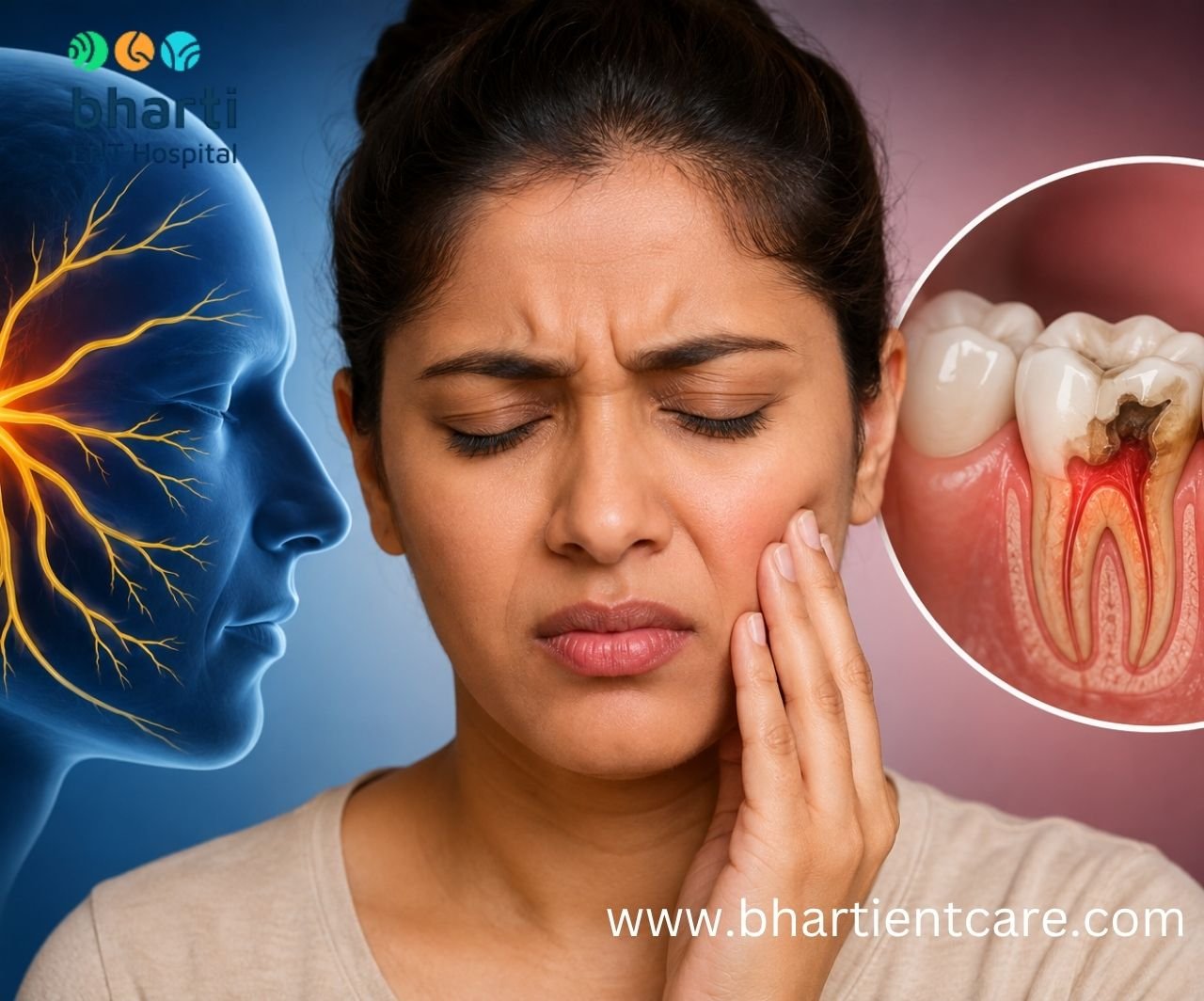
The pain of trigeminal neuralgia can be very much like tooth pain as the trigeminal nerve is responsible for transmitting the sensation from the teeth, gums, jaw, cheek and other parts of the face.
One of the reasons trigeminal neuralgia may be mistaken for a dental problem is because of this.
Individuals with TN can experience pain as follows:
- An electric shock
- A sudden stabbing sensation of pain.
- A sharp shooting pain
- Severe facial pain
- A burning or stabbing sensation.
- Sudden pain in the jaw or teeth area
The pain tends to be unilateral (one-sided) and may be exacerbated by routine activities like chewing, talking, brushing teeth or touching the face, or by a cool breeze.
Since the pain may be felt around the teeth and gums, many people will seek out their dentist first. This is a reasonable first move as common dental issues like tooth decay, infection or a cracked tooth must also be excluded.
So the big question is, not just “Is this tooth pain?”.
It is:
Does the pain follow a pattern of a dental issue, or is it a nerve-related facial pain condition like trigeminal neuralgia?
What is the difference between tooth pain and Trigeminal neuralgia?
The most striking difference is often the nature of the pain: Trigeminal neuralgia is generally brief, intense, and shocking, and can be provoked by light stimulation of the face, whereas dental pain is often continuous, aching or throbbing, and is related to a specific tooth or dental issue.
However, there can be overlap, so symptoms alone cannot always establish the diagnosis.
| Feature | Trigeminal Neuralgia | Common Dental Pain |
| Pain character | Electric shock, stabbing or shooting | Aching, throbbing or persistent |
| Duration | Often seconds to minutes per attack | Can persist for hours or longer |
| Location | Often one side of face, jaw, teeth or gums | Usually associated with a particular tooth or area |
| Trigger | Touch, chewing, talking, brushing, wind | Hot/cold foods, biting, infection or pressure depending on cause |
| Between attacks | May have little or no pain | Pain may continue between triggers |
| Dental examination | May not reveal a dental cause | Often identifies a dental problem |
| Dental X-ray | May not show a dental explanation | May show decay, infection or other problems |
| Main cause | Trigeminal nerve dysfunction | Tooth, gum or surrounding dental structures |
This comparison is general and should not be used for self-diagnosis. There are numerous causes of facial pain and a medical specialist or dentist may have to look at the symptoms.
What is the typical pain like for Trigeminal Neuralgia?
The pain from trigeminal neuralgia is usually sudden and very intense and it may be described as an electric shock, stabbing sensation or sharp jolt in the face.
The trigeminal nerve has three main branches, which supply sensation to parts of the face.
This can thus lead to pain around the:
- Upper jaw
- Lower jaw
- Cheek
- Teeth
- Gums
- Lips
- Nose
In some instances the eye or forehead is affected.
The pain is commonly experienced on one side of the face.
What does normal toothache feel like?
Depending on the dental problem, dental pain can be more continuous, and can feel like aching, throbbing, sensitivity or pain when biting or exposure to temperature changes.
Some dental causes may be:
- Tooth decay
- Dental infection
- Dental abscess
- Cracked tooth
- Gum disease
- Inflammation of the tooth pulp
- Difficulties after dental treatments
- Impacted teeth
A decayed tooth can be sensitive to hot or cold foods, for instance. Infected tooth may cause on going pain, swelling or tenderness.
Cracked tooth can affect the ability to bite and release the bite and may cause pain.
Depending on the dental condition, the symptoms vary, so a dental examination is important if there is tooth pain.
How is trigeminal neuralgia sometimes confused for a toothache?
It is easy to confuse trigeminal neuralgia with the pain of toothache, as the trigeminal nerve sends sensory signals from the teeth, gums and jaw to the brain.
If the nerve malfunctions, the brain may read the abnormal nerve signals as pain in parts of the body that are served by the nerve.
- This can lead a person to believe:
- I have an infection in my tooth.
- I have a problem with my tooth, I need a root canal.
- There’s no doubt in my mind about the fact that there must be a hole.
- The pain is due to my wisdom tooth.
If, however, a dental examination and suitable imaging does not reveal a clear cause of the problem, then a nerve-related cause may be considered.
How to know if the pain in your teeth is a nerve pain?
If the pain is sudden, electric shock-type pain, very intense and triggered by light touch or normal movements of the face, it may indicate nerve-related pain in the face and not the usual tooth pain.
Pay attention to the pattern.
Symptoms which can indicate trigeminal neuralgia.
- Sudden electric-shock-like pain
- Very intense but brief attacks
- Unilateral facial pain is defined as pain on one side of the face
- Dentin hypersensitivity is a condition that causes pain when brushing your teeth
- Chewing which causes pain
- When pain is caused by talking
- When the pain occurs when you touch your face
- Facial pain from shaving or washing your face
- Cold sensitivity, wind sensitivity; cold/wind-aggravated pain
- Seeking dental care but no dental cause is found on examination
These are the signs of trigeminal neuralgia, but do not diagnose the condition on their own.
Is Trigeminal Neuralgia Painful in Teeth and Gums?
Yes. The pain from trigeminal neuralgia may be experienced in the teeth and gums though the teeth may be healthy.
This nerve also carries sensation to the teeth and gums and abnormal activity can be felt as dental pain.
This is particularly important when:
- Several teeth appear to be painful
- The location of pain seems to move
- Dental treatment doesn’t alleviate the pain.
- X-rays of the teeth do not provide any information about the symptoms.
- Sudden attacks of pain
- A slight push is a hard push!
Patients should not automatically assume that if their tooth pain is not related to trigeminal neuralgia, then it isn’t, but if the pain is in their face or teeth and it is unexplained, then it should be further evaluated.
What Tests are done for Trigeminal Neuralgia?
No single test can confirm all cases of trigeminal neuralgia; diagnostic criteria are largely dependent on the patient’s pain pattern, triggers, location and clinical examination, and an MRI may be occasionally ordered to investigate possible causes.
A doctor may ask:
- What is the location of pain?
- On one side or both sides?
- What is the duration of each attack?
- How often does it happen?
- What causes the pain?
- Does chewing cause it?
- Does toothbrushing make it happen?
- Does it happen when you touch your face?
- Have you had dental treatment?
- Was dental care helpful with the pain?
A neurological exam may also be conducted.
If appropriate, an MRI may be suggested to rule out any potential causes that could involve the trigeminal nerve, such as vascular compression, multiple sclerosis or a structural lesion.
When to Visit a Dentist vs. an ENT for Facial Pain?
If the pain seems to be coming from a tooth or gum, a dental exam is a logical first step, and if the pain does not seem to be from a dental cause, but has a characteristic nerve-related pattern then further medical or specialist evaluation may be appropriate.
It’s not a case of either/or.
A patient may need:
Dentist → check for dental causes.
followed by:
Medical/ENT/neurological evaluation: If the pain in the facial nerves is not explained, then investigate further.
With this method, patients won’t need to have unnecessary dental work when the real cause of their discomfort is elsewhere.
Careful evaluation of the cause of orofacial pain may be necessary when dental problems and trigeminal neuralgia are difficult to differentiate, Mayo Clinic notes.
What if the dentist says there is nothing wrong with your teeth, but the pain persists?
If the pain persists on the face or similar to teeth pain, even after a routine dental exam, it is important to consult a doctor for further evaluation, not just consider it to be dental-related.
This is even more significant when the pain:
- Has electric shock-like attacks
- Is always on one side of the coin.
- Is activated by touching the face
- Is found when chewing or talking.
When you brush your teeth does it cause this?
Happens without an obvious dental problem
One of the potential causes is trigeminal neuralgia, but there are other possible causes of facial pain as well.
What Are the Common Triggers of Trigeminal Neuralgia?
Common triggers include chewing, talking, brushing the teeth, touching the face, shaving, washing the face and exposure to wind or cool air.
Triggers vary between individuals.
For some people, even a very light stimulus can cause a severe attack.
Common triggers include:
- Brushing teeth
- Eating
- Drinking
- Talking
- Smiling
- Shaving
- Washing the face
- Applying makeup
- Touching the cheek
- Cold air
- Wind
- Air conditioning
Is Trigeminal Neuralgia Worse than Tooth Pain?
The pain associated with trigeminal neuralgia may be very intense, but the severity of the pain is not enough to differentiate it from a serious dental condition.
Asking how painful is the pattern rather than asking how painful is is often more helpful.
Some people with severe dental infection may have a lot of pain all the time, while some people with trigeminal neuralgia may have very intense but short “electric shock” pain attacks that occur frequently.
So, don’t rely on the severity of the pain to make a diagnosis.
Instead, consider:
- What does the pain feel like?
- What is its duration?
- What triggers it?
- In what places can it be found?
- What was revealed by the dental exam?
When to Call a Doctor for Facial or Tooth-like Pain?
If the face pain is more severe, persistent, recurrent and not explained by a dental examination, or if there is some unusual neurological symptoms, medical evaluation should be sought.
Further evaluation should be done if:
- Your dentist is unable to determine the cause.
- Dental treatment has not helped the pain.
- Pain repeatedly occurs on one side
- You have electric shock-type seizures
- With light touch, it is intense pain.
- Pain keeps returning
- The pain makes it difficult to eat or talk
- Facial numbness or weakness occurs.
New facial numbness is especially significant, as it is not the characteristic symptom of classic trigeminal neuralgia and could warrant a search for other underlying causes.
If your facial pain is accompanied by new neurologic symptoms (sudden weakness or numbness of an arm or leg, trouble walking, trouble speaking or weakness of the face), see a doctor immediately for signs of a neurologic emergency or severe new headache.
What are the treatments for Trigeminal Neuralgia?
Treatment will be based on the cause and severity of the symptoms, and individual patient factors and may be required to use medication or specialist procedures, if appropriate.
Treatment is not a treatment for a tooth that is infected.
Medications that are specifically used for nerve pain may be considered by doctors. Medications may be used if they are not sufficiently effective or if side effects are troublesome, specialist procedures may be considered in selected patients.
Treatment should be personalized following a proper diagnosis.
What are the services provided by Bharti ENT Care for those suffering from Trigeminal Neuralgia in Vadodara?
Dr. Bhavin Parikh from Bharti ENT Care has specific clinical expertise in trigeminal neuralgia in addition to his expertise in otology, neurotology and lateral skull base surgery.
Dr. Bhavin Parikh is a consultant, Otologist and Lateral Skull base surgeon at Bharti ENT Care Hospital, Nizampura, Vadodara as per the official doctor profile page on the website. His areas of specialization are trigeminal neuralgia, facial palsy, hemifacial spasm, acoustic neuroma and peripheral vertigo.
When a patient complains of an unknown facial or tooth-like pain, the first step in the clinical process should be to determine the pattern and source of the pain, not to immediately suspect dental or neurological pain.
A specialist assessment can take into account:
1. Understanding the pain pattern
The doctor can ask about:
- Location
- Duration
- Frequency
- Intensity
- Triggers
- Previous dental treatment
- Associated symptoms
2. Considering dental causes
If it is around the teeth and/or jaw, appropriate dental causes should be ruled out.
3. Assessment of nerve related facial pain
If the dental examination does not provide an explanation for the symptoms, and the pain pattern is suggestive of trigeminal neuralgia, further specialist assessment may be appropriate.
4. Taking into account imaging as needed
Depending on the clinical findings, MRI or other tests might be suggested to rule out potential causes of trigeminal nerve compression or other causes.
5. Discussing treatment options
Treatment can then be chosen based on the patient’s condition, after a diagnosis is made.
Dr. Bhavin Parikh is listed as having 23 years of experience by Bharti ENT Care and his specializations include trigeminal neuralgia.
What are the options for a patient to get evaluated for facial pain in Vadodara?
Bharti ENT Care Hospital is located at Kunj Centrum, Nizampura Main Road, Vadodara.
Bharti ENT Care also has its Bharti ENT Care Clinic in Gotri.
Dr Bhavin Parikh is a specialist in Trigeminal Neuralgia and other neurotological disorders as per the hospital’s official website.
Why is the correct diagnosis important before treating tooth pain?
An understanding of a toothache is easy: most people would think that pain in the tooth itself is coming from the tooth itself.
However, not every toothache is due to a problem in the tooth itself.
An example of this is important is, of course, trigeminal neuralgia.
The pain can occur in the teeth, gums and jaw even though the underlying problem involves the trigeminal nerve.
This is why repeated treatment of teeth without determining the cause of the unexplained pain may not resolve the issue.
Useful is:
Pain pattern → Dental examination → Other causes considered if appropriate → Specialist evaluation (if indicated) → Correct diagnosis → Targeted treatment
Identifying this difference can help patients in Vadodara and its environs seek the right specialist earlier, especially when there is no apparent cause for their severe facial pain that persists despite having healthy teeth.
Frequently Asked Questions
Is trigeminal neuralgia like a toothache?
No, Trigeminal neuralgia is a disorder of the nerves and dental pain is typically caused by a dental issue. But trigeminal neuralgia can also cause a feeling of toothache because the trigeminal nerve is responsible for providing sensation to the teeth and gums.
How can I tell if my tooth pain is trigeminal neuralgia?
Electric-shock-like, stabbing facial pain that happens in short attacks and is set off by touching the face, chewing, talking or brushing the teeth are indicative of trigeminal neuralgia. A dental and medical exam is required to see what the real cause is.
Is it possible for trigeminal neuralgia to affect a single tooth?
Yes. A patient may experience pain in one or more teeth, especially if the affected branch of the trigeminal nerve is the one that innervates the tooth.
Does a root canal cause trigeminal neuralgia to get worse?
A root canal will not help trigeminal neuralgia. If the pain is caused by inflammation of the trigeminal nerve and not from the tooth, dental care will not help alleviate the pain.
If my dentist says that my teeth are fine but the pain persists, what should I do?
Ask your doctor if you should get more tests to check for other causes of facial pain that aren’t dental. The possibility of trigeminal neuralgia needs to be ruled out, though.
Is trigeminal neuralgia a constant pain?
In general, classic trigeminal neuralgia presents as short episodes of severe pain, not as a steady pain; however, a few patients may experience a steady facial pain or other symptom patterns.
Does brushing your teeth cause trigeminal neuralgia?
Yes. Teeth brushing is known to be a trigger as it can stimulate the face or mouth even slightly in some people, which can trigger an attack.
Is a trigeminal neuralgia diagnosed by an MRI?
MRI cannot confirm the diagnosis of trigeminal neuralgia, but may be used to help narrow down the possibilities and exclude other disorders. The diagnosis is mainly made on the basis of the typical history and examination.
Is trigeminal neuralgia serious?
Although the pain associated with trigeminal neuralgia itself is not typically life threatening, it is important to get a proper diagnosis of the condition if the pain is severe or if it is not known to be trigeminal neuralgia. Any new neurological symptoms should be assessed promptly.
Who is the best Trigeminal Neuralgia Doctor in Vadodara?
Dr. Bhavin Parikh, a specialist at Bharti ENT Care, mentions trigeminal neuralgia in his specialties. Neurological/neurosurgical involvement may also be considered based on the underlying cause and treatment needed.