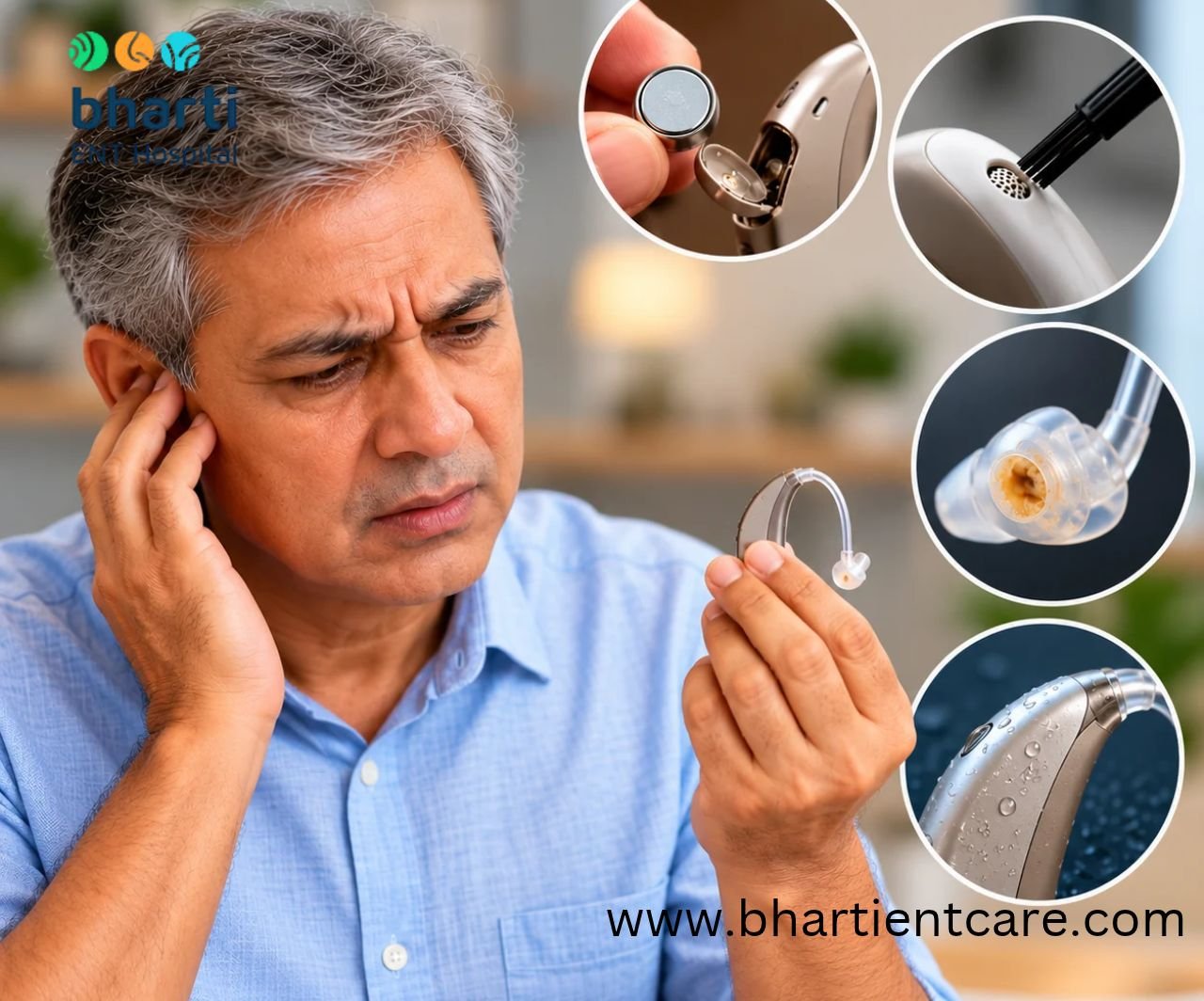
The purpose of a hearing aid is to help people hear sounds more clearly and communicate more easily. But, as with any electronic gadget, they do fail, sometimes. Your hearing aid not working might have a simple problem like low battery, the microphone may be blocked, your ears may have accumulated ear wax, it may be damp, or the settings may be incorrect.
Many issues can be solved by simple home checks, others need expert assessment. The following are some of the most common hearing aid issues and knowing about them can help you determine what may be trouble, as well as when you should reach out to your audiologist.
Why Your Hearing Aid May Stop Working
A hearing aid may not function or may not hear clearly for a variety of reasons. Common causes include:
- Low or depleted battery
- Charging problems
- Blocked microphone
- Blocked or damaged receiver
- Earwax accumulation
- Moisture exposure
- Incorrect settings
- Physical damage
- Loose components
- Any alteration in your hearing
- Any hearing changes
If your hearing aid suddenly stopped working, make sure to perform some basic tests and see if it can be fixed.
What to Check: Hearing Aid Has No Sound!
A very common problem with a hearing aid is that it doesn’t make sound. When making a hearing health care consultation, review the following.
1. Check the Battery
If the hearing aid is battery operated, ensure that the battery is in place and has a good charge. Replace it with a new battery if necessary.
With rechargeable hearing aids, ensure the device is properly placed in its charging device and see if the charging indicator operates.
2. Make Sure the Device Is Turned On
Sometimes the device seems to be stopped due to a simple power problem. If the hearing aid will not turn on, verify the power button, battery compartment and charging status.
If using a reusable hearing aid, check in the charger to make sure the contacts are clean and the charger is plugged in properly.
3. Check the Volume and Program Settings
The hearing aid might be set to a misappropriate program or might be set too low. Adjust listening program or volume as per device directions.
If sounds are still unclear, don’t turn the volume up too high, as there may be a problem that needs a professional evaluation.
Hearing Aid Is Producing Weak Sound
However, if your hearing aid is sounding weak, it doesn’t necessarily mean there is an electronic issue.
Possible causes include:
- Low battery power
- Blocked microphone
- Blocked receiver
- Earwax buildup
- Moisture
- Incorrect device settings
- Changes in hearing
Always check the battery or charging level first. If the device seems to be operating but the sound is abnormally low, check the microphone openings and receiver by following the manufacturer’s cleaning recommendations.
If the issue persists, an audiologist can find out if the hearing device or your hearing has altered.
Hearing Aid Working Intermittently
A hearing aid that operates from time to time can be very annoying if it starts to work for a few minutes and then turns off.
Possible reasons include:
- Weak battery
- Poor battery contact
- Charging problems
- Moisture
- Loose components
- Damaged wiring/parts inside the appliance
If the hearing aid is rechargeable, ensure the hearing aid and charger contacts are clean and the hearing aid is placed correctly in the charger.
If a problem persists even after simple troubleshooting, a professional inspection is suggested.
Hearing Aid Working Intermittently
If both hearing aids are functioning properly, but one is not working in one ear and working well in the other, it might be a problem with that hearing aid.
Check:
- If the problem device has enough battery.
- If the receiver/microphone is obstructed.
- To check if the device is charging properly or not.
- The presence of moisture or physical damage.
- If the hearing aid is plugged in and set properly.
- Don’t assume that the hearing loss has just changed if one device is still not working.
An audiologist can test the hearing aid to see if the problem is the device, programming or due to the hearing loss itself.
Battery and Charging Problems
One of the easiest things to forget to check when troubleshooting a hearing aid is related to batteries.
For disposable batteries:
- Test to see if the battery is “dead.
- Verify that it is inserted in the right direction.
- Follow the recommended battery type for your device.
- Store unused batteries as per manufacturer’s instructions.
If you have a rechargeable hearing aid:
- Determine if there is power to the charger.
- Make sure the hearing aids are positioned correctly.
- Clean charging contacts as per instructions.
- Verify responsiveness of charging indicator.
- Charge according to manufacturer’s instructions.
If the hearing aid continues to turn off even after it has been fully charged or new batteries have been used, a professional check-up might be required.
Blocked Microphone or Receiver
If the microphone or receiver is muffled, it may not capture as much sound for your ear.
Over time, earwax, dust and debris can build up around the parts of a hearing aid. This will cause a decrease in volume, distortion or no sound at all.
Only clean the device as specified by the manufacturer. Never put sharp objects into the microphone or the receiver openings as this will destroy sensitive parts of the receiver.
It may be necessary to get professional evaluation if you think that earwax is interfering with your hearing or the hearing aid’s function. Learn more about earwax removal and when it’s necessary to seek professional earwax cleaning.
Moisture and Earwax Problems
There are several factors that can impact the performance of hearing aids, such as moisture and earwax.
Moisture
Water, humidity, rain and accidental exposure will impact the parts of the hearing aid. Even if the device is rated to some extent to withstand water or moisture, it is crucial to read the manufacturer’s guidelines for water and moisture exposure.
Follow the drying procedure outlined by the hearing aid’s manufacturer if it gets wet. Avoid using excessive heat (e.g. hair dryer) unless recommended by the manufacturer.
Earwax
Ear wax can also trap the ear canal, and can also collect around the hearing aid. This may lead to decreased audio quality and sometimes contribute to feedback.
If you have frequent ear clogging, muffled or poor hearing even when your device seems to be working, an ENT evaluation may assist you to determine the cause of the issue.
Hearing Aid Troubleshooting: A Simple Checklist
When facing a hearing aid not working problem, work through this checklist:
| Problem | What to Check |
| No sound | Battery, charging, volume, microphone and receiver |
| Device won’t turn on | Battery, power button and charging connection |
| Weak sound | Battery, blocked components, settings and earwax |
| One device not working | Battery, receiver, microphone and connection |
| Intermittent sound | Battery contact, moisture and internal components |
| Whistling or feedback | Fit, earwax, volume and device settings |
| Distorted sound | Moisture, blocked components or device damage |
This basic hearing aid troubleshooting process can help identify simple issues, but it should not replace professional evaluation when problems persist.
When You Should See an Audiologist
Timing when to go to an audiologist is important, especially if trouble shooting doesn’t work.
If any of these conditions apply, please consider professional evaluation:
- Your hearing aid repeatedly stops working.
- One hearing aid consistently produces no sound.
- Sound remains weak despite changing the battery.
- The device has been exposed to water or significant moisture.
- You notice persistent distortion or unusual sounds.
- Your hearing seems to have changed.
- You experience sudden hearing loss.
- Your hearing aid causes persistent discomfort.
- You need repeated adjustments to hear comfortably.
Your audiologist has the ability to examine the hearing aid, set it, assess how well you can hear with it, and see if it needs cleaning, programming, repair, or replacement.
Professional Hearing Aid Troubleshooting
There are times when simple inspections are not sufficient. A hearing aid expert can also help diagnose issues that might be hard to diagnose at home.
When undergoing an evaluation, an audiologist or hearing health care provider might examine:
- Hearing aid functionality
- The ability to deliver battery or charging performance.
- The condition of the microphone and receiver.
- Device programming
- Hearing aid fit
- Sound output
- Wax build-up in the ear canal and ear wax.
- Changes in hearing
However, if your hearing has changed, you might need to adjust the hearing aid in order to solve the problem. Depending on the device, it may require a hearing assessment to see if the device needs to be programmed differently or if another hearing solution is more effective.
You can also delve into hearing tests and audiology services, and find out how your hearing might be assessed.
Can You Self Repair a Hearing Aid?
A few minor issues can be solved at home, for example when the battery is flat, you may need to replace it, and if the charging connection doesn’t feel correct, you can check it out, or clean the device following manufacturer guidelines.
Do not open hearing aid or do internal repair work, however. Hearing aids have delicate electronic components and if handled incorrectly, this can cause further damage.
For devices that have been dropped, exposed to water, physically damaged or frequently failing, professional inspection is a better choice.
How to Prevent Hearing Aid Problems
With proper maintenance, the problems that might occur with hearing aids can be minimized.
Avoid treating the Device with any liquids.
Clean the microphone, receiver and other easily accessible parts according to manufacturer’s instructions and periodically check.
Keep it dry!
Avoid unnecessary water exposure and adhere to manufacturer’s moisture protection suggestions.
Store It Properly
Keep hearing aids in a case as per the manufacturer’s instructions and avoid excess moisture and heat when not in use.
Schedule Hearing Checks
You can have regular hearing checks to detect any changes of hearing and to see if your hearing aids are working properly.
Get Professional Adjustments
Don’t turn up the sound if it’s uncomfortable, unclear, or too soft. Your hearing aid could require professional programming or adjustment.
Final Thoughts
If a hearing aid is not working correctly, it doesn’t necessarily mean it’s time to replace it. These problems can cause problems like low batteries, charging problems, blocked microphones, blocked receiver, moisture, earwax, and incorrect settings.
Check first for simple things, but if you have an ongoing issue, if the problem occurs on just one device or if you notice that your hearing changes, then check a professional. An audiologist can test your hearing and your hearing aid to determine the best solution for you.
If you have hearing issues that are recurring, consider audiology consultation and a professional hearing assessment, instead of home troubleshooting.