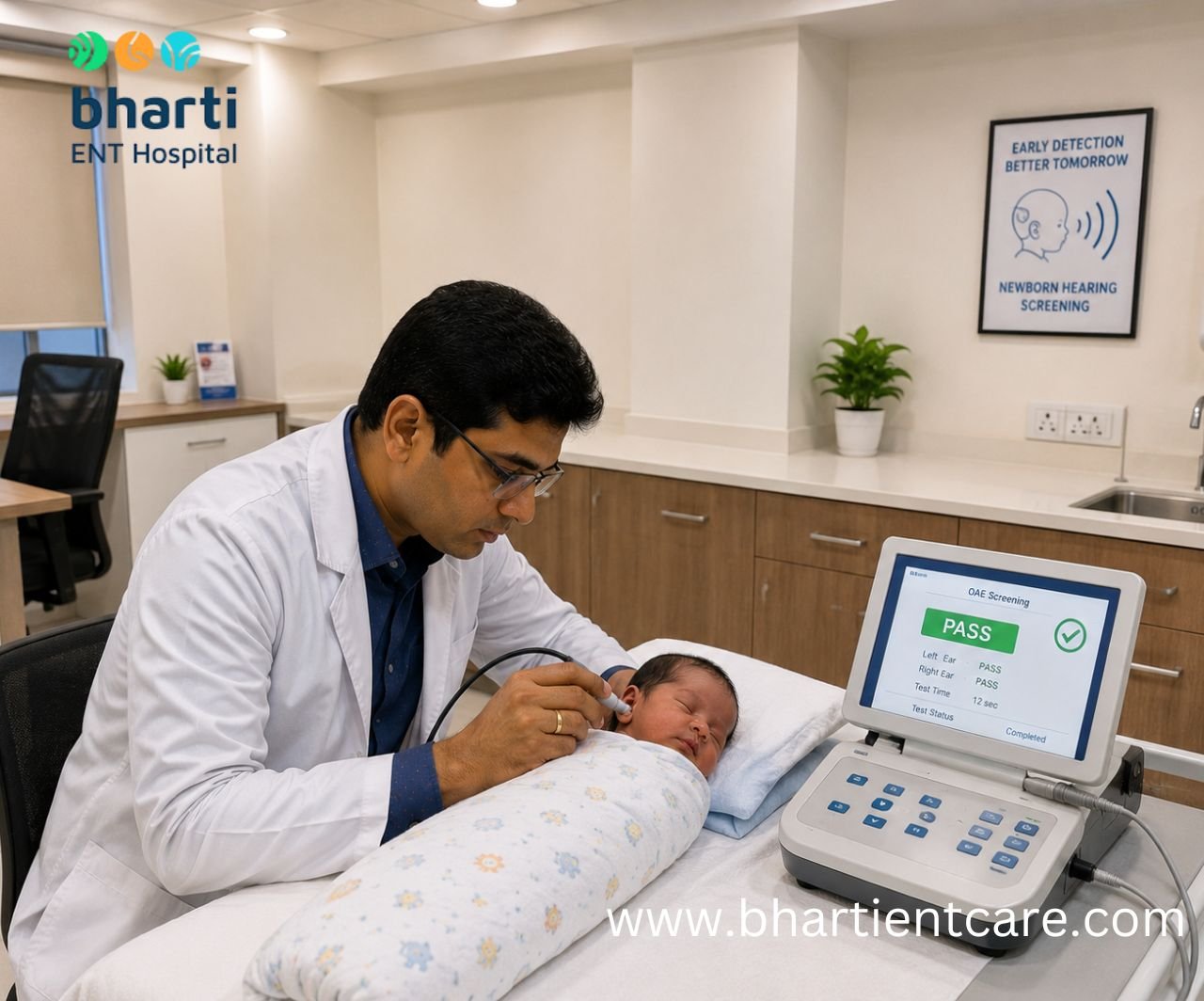
Speech, language and brain development are closely linked during the first few months of a baby’s life. The infant starts identifying voices and sounds almost right from the beginning and the initial sounds have an impact on later communication. Bharti ENT Hospital considers newborn hearing screening as a crucial measure to identify hearing problems before they start to impact the child’s growth and learning potential.
The problem is that hearing loss usually isn’t apparent. Families may not notice hearing loss at first because the baby is healthy, sleeps normally, and reacts to vibrations or visual movement. Hearing problems that are not diagnosed in time may affect speech development, emotional expression, social skills and school performance.
Newborn hearing screening can help to detect potential hearing problems within the first days or weeks of life. Early diagnosis also allows parents sufficient time to research treatment options, hearing therapies, and treatment plans for managing hearing in the long-term. Hearing screening is recommended by medical experts around the world to be done before one month of age, diagnostic assessment if necessary before three months and intervention before six months.
Today, parents are more aware of preventive hearing care and are looking for advanced diagnostic support for children as well as adults like an audiology test in Vadodara. This increasing consciousness is aiding many households to tackle hearing issues at an earlier stage, before they develop into a serious matter.
Understanding Newborn Hearing Loss
Infants can develop hearing impairment as a result of genetics, complications in the womb, premature birth, infections, low birth weight, or certain medications. Sometimes the risk factor may not be apparent. That is why screening for hearing loss in all infants has grown in significance in today’s healthcare system.
If a baby has hearing loss, they may not respond to sounds in a consistent manner, they may not react to loud sounds, and may take longer to develop speech. However, these signs are typically only apparent after several months and this may delay treatment. Early screening can fill this gap, detecting problems right after birth.
Newborns have a variety of levels and types of hearing loss. Mild hearing loss or moderate, severe or profound hearing loss may occur in some children. Loss of hearing can occur in one or both ears. It can also be temporary as a result of fluid accumulation or permanent as a result of inner ear or nerve problems.
Research by the National Institute on Deafness and Other Communication Disorders (NIDCD) also shows that children who are diagnosed early (before 6 months of age) tend to acquire language skills much better than those who are diagnosed at a later age.
It is also important for parents to realize that hearing health is related to general health and development. Regular screening provides good base for preventive care. If a baby clears the initial test, they may need further tests later if they have speech delays or developmental problems.
How Newborn Hearing Screening Is Performed
Newborn Hearing Screening (NHS) is painless, non-invasive and typically performed while the infant is sleeping. It is usually not painful or uncomfortable and only takes a few minutes. There are two common screening tests for screening newborn hearing ability that are used in hospitals and audiology centers.
Otoacoustic Emissions (OAE)
This test looks at the sound waves that are generated within the inner ear. A soft probe is gently inserted into the baby’s ear canal. The sound produced by the device is of low intensity and the device records the response of the ear. If the inner ear reacts normally to the test, the baby passes the test.
Auditory Brainstem Response (ABR)
The ABR test evaluates the hearing nerve and brain’s reaction to sound. A gentle sound is given through earphones and small sensors are attached to baby’s head. The machine is used to capture brainwaves of sounds.
Such tests are very useful in detecting hearing problems at an early stage, particularly in infants who are not able to verbalize their concerns. Passing the initial screening does not necessarily indicate that the child won’t have permanent hearing loss. Results may be affected by temporary fluid, movement during testing or background noise. Further tests or a thorough evaluation may be suggested.
New audiological equipment should be capable of precise hearing evaluation in all age groups. These include sophisticated hearing assessment equipment, speech audiometry equipment, tympanometry tests, hearing aid programming support and pediatric hearing diagnostics. These services support specialists to develop customized hearing management plans in response to the patient’s condition.
Benefits of Early Diagnosis and Intervention
When hearing loss is detected early, the better the prognosis for the child.
- Early intervention helps children develop their language skills normally, social communication skills, and their readiness to learn. Early support for deaf children helps them adapt to communication more effectively.
- Individualized hearing support can make a profound difference in helping children with hearing impairment to communicate better in daily life. Many families also consider the advanced hearing aids in Vadodara to enable children to hear better and engage with social and educational activities with confidence.
- Depending on the severity and type of hearing loss, intervention may involve hearing devices, speech therapy, auditory training, family counseling and medical treatment. A hearing amplification system could help some children hear better during their formative years, when they are most susceptible to the effects of hearing loss.
- Many parents are astonished to discover how quickly their baby’s brain grows during the early stages of development. During this window, sound stimulation is important in developing neural pathways which form the basis for understanding language and producing speech. Failing to participate in these experiences for an extended period of time can make language learning a bit more challenging later on.
Additionally, parents need to be aware of the common misconceptions of ear and hearing care. Learning facts about hearing and ear care aids in the promotion of preventive health practices.
When Parents Should Seek Further Evaluation
Parents should continue to check developmental hearing milestones throughout the child’s development after newborn screening is done. Others develop at a later stage due to infections, genetic progression, trauma or other medical conditions. It is important to note that early signs of potential hearing impairment may include:
- Limited response to familiar sounds
- Delayed speech development
- Problems locating the direction of sound
- Frequent ear infections
- Failure to respond to loud noises
- Inconsistent communication responses
If parents have any concerns, they should see an ENT specialist. A thorough examination of the hearing will determine whether the problem is temporary or permanent.
Advanced diagnostic systems are used in comprehensive audiological centers to evaluate children’s hearing. They can be configured with pure tone audiometry, impedance audiometry, speech audiometry, OAE and ABR testing, and hearing rehabilitation support. The correct diagnosis enables doctors to determine the optimal treatment strategy for a particular child, depending on their age and their hearing profile.
The psychological factor of hearing loss is not to be overlooked either. A parent’s reaction to a screening result that is not normal is a natural anxiety, but many things have changed in the field of hearing care and the outcomes of early intervention. Children who have experienced early hearing loss and are treated early can communicate well and live active, social lives.
Building a Strong Foundation for Lifelong Hearing Health
Newborn hearing screening isn’t merely a routine medical procedure. It is a crucial preventive health practice that impacts a child’s communication, education and social skills for years. Early detection will allow families to start treatment early, receive professional advice and guidance and enable healthy developmental milestones from the start.
Advanced hearing evaluation systems and specialized audiological services at Bharti ENT Hospital ensure the accessibility of reliable hearing evaluations and treatment support for families. Early hearing care is essential for enhancing the quality of life and the long-term communication outcomes of newborn screening through detailed hearing diagnostics and rehabilitation advice.
Frequently Asked Questions (FAQs)
What are the hearing evaluation tests that can be conducted at Bharti ENT Hospital?
Audiometry, Impedance Audiometry, BERA (Brainstem Evoked Response Audiometry), and OAE (Otoacoustic Emissions) are possible.
Does Bharti ENT Hospital offer Hearing screening services for newborns?
Yes, the hospital has an audiology department that performs newborn hearing screening.
If a baby fails the hearing screening, what happens?
Repeat tests or a comprehensive diagnostic hearing test are typically recommended to confirm the results.
Is it safe for newborns to take hearing tests?
Absolutely, newborn hearing screening tests are 100% safe, non-invasive and are typically done when the baby is asleep.
How is hearing rehabilitation planned for children?
The specialists examine your hearing level step by step and recommend appropriate therapy, monitoring, or supportive hearing devices.