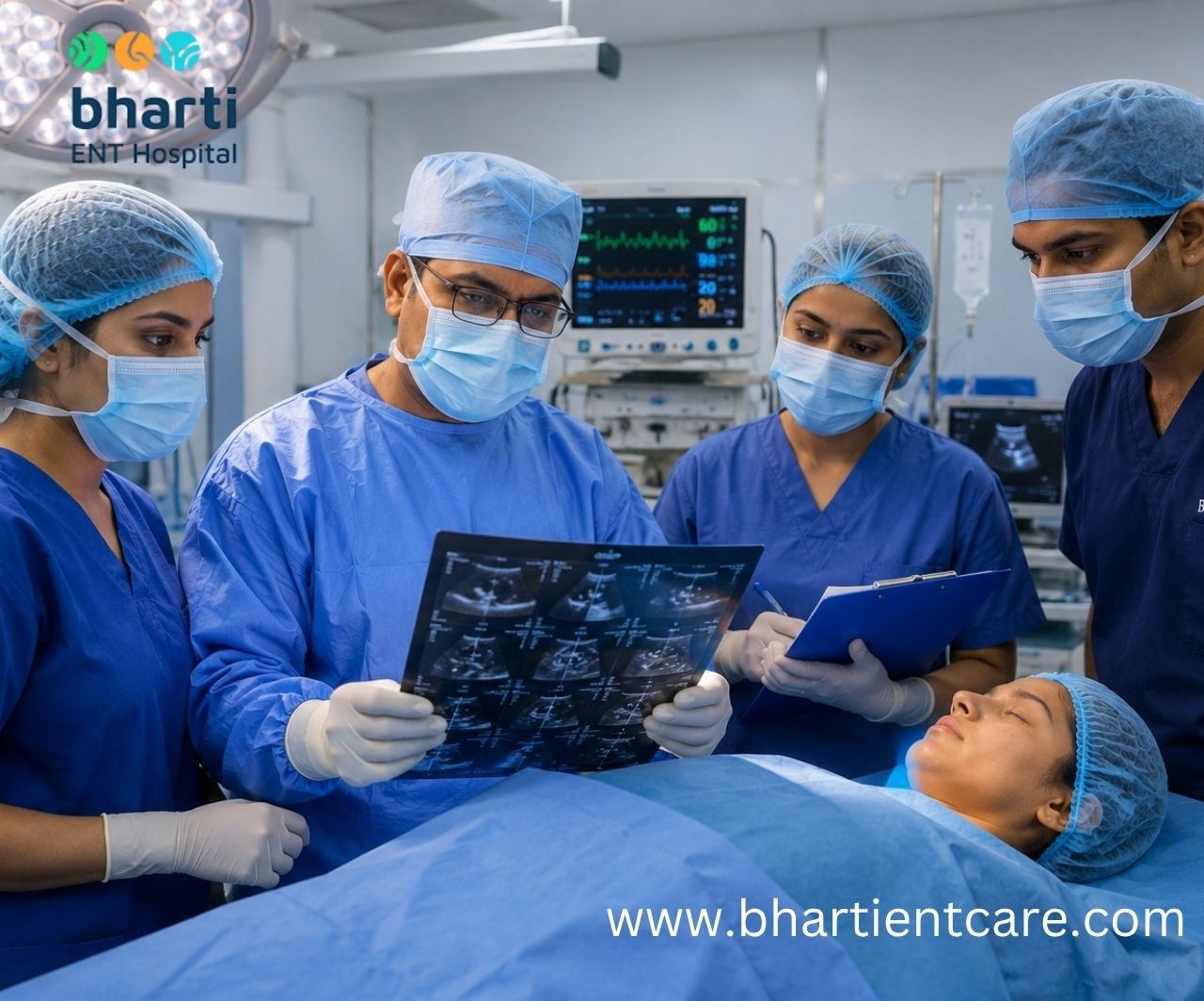
Thyroid is a butterfly-shaped gland in the front of the neck that makes hormones that play a role in several important functions of the body and help to control the body’s metabolism.
Depending on the patient’s condition, a surgeon may remove:
- Partial thyroidectomy or lobectomy is part of the thyroid.
- Most of the thyroid
- A thyroidectomy, which removes the whole thyroid, is performed.
The amount of thyroid tissue removed will depend on the cause of surgery, the nature of the thyroid condition and the patient’s personal situation.
Thyroid surgery is considered for thyroid cancer, thyroid nodules that need further evaluation, some goiters that are large or may have symptoms, and some cases of hyperthyroidism.
When is a thyroid removal surgery recommended?
Surgical removal of the thyroid may be suggested when a thyroid nodule or tumour is cancerous or when there is a significant hyperthyroid symptomology, or in certain hyperthyroid patients.
The American Thyroid Association recommends that thyroid surgery be considered in the following cases:
- Thyroid cancer
- Nodules in the thyroid gland that are abnormal and may be cancerous
- Goiter which is large enough to interfere with swallowing or breathing
- Some cases of overactive thyroids
- Growth of some nodules or large enough to cause symptoms
But having a thyroid nodule doesn’t necessarily mean that surgery is required.
A thorough clinical examination, an ultrasound of the thyroid, and fine-needle aspiration may be performed to assess the nodule, as appropriate, by a doctor.
Should all thyroid nodules be operated on?
No. Rarely, surgery is indicated for thyroid nodules. The decision depends on factors such as ultrasound characteristics, biopsy results, size, growth, symptoms and the possibility of cancer. Nodules that are not cancerous may be treated with simply follow-up exams and ultrasound. Even if a nodule is benign, it might need surgery if it continues to grow, has ultrasound characteristics that warrant further evaluation, or if it produces symptoms.
The typical evaluation might then be:
Thyroid lump → Clinical examination → Ultrasound → FNAC when indicated → Risk assessment → Monitoring or treatment
This way, patients can prevent any unnecessary surgeries and also not miss any suspicious thyroid issues.
Why should thyroid surgery be performed for thyroid cancer?
Thyroidectomy is often suggested for thyroid cancer because the removal of the cancerous thyroid tissue may be a crucial component of treatment.
The amount of surgery will depend on:
- The type of thyroid cancer
- Size of the tumour
- If cancer is limited to one lobe of the thyroid
- Whether lymph nodes are affected or not
- If the cancer has grown outside the thyroid
- A variety of other features were identified during evaluation
In some cases, surgery doesn’t involve the complete removal of the thyroid gland.
Recent American Thyroid Association recommendations favor personalized treatment of selected differentiated thyroid cancers, allowing for a choice between lobectomy and total thyroidectomy based on the characteristics of the tumour and other factors.
That’s why, in every patient, it is important to discuss with patients how much thyroid is being removed, and not take it for granted that “thyroid cancer = total thyroidectomy.Therefore, it is important to discuss with the patients how much thyroid is being removed, and not assume that in every patient, “thyroid cancer = total thyroidectomy.
Is surgery necessary for a Benign Thyroid Nodule?
Yes. Sometimes surgery is needed for a benign thyroid nodule if it becomes large, grows or causes symptoms or other clinical problems.If the biopsy is normal, this does not guarantee that surgery is not possible.
A large thyroid nodule or goitre can lead to:
- Difficulty swallowing
- Pressure in the neck area.
- Difficulty breathing
- Problems lying flat
- Visible neck swelling
- Persistent discomfort
Surgery may be recommended in some cases where benign nodules continue to grow or cause symptoms, according to the American Thyroid Association.
The decision should not be made based solely on the word “benign” in the biopsy report, but rather should be made on an individual basis.
Will an enlarged thyroid or goitre require surgery?
Yes. If the enlarged thyroid or goitre is symptomatic, causing pressure symptoms, or a problem with swallowing or breathing, then surgery may be recommended. A goitre is the swelling of the thyroid.
Occasionally, goitres are small and can be watched. They can grow to a size that crushes nearby structures in the neck.
Symptoms can include:
- Difficulty swallowing
- Shortness of breath
- A tightness or sensation of pressure in the neck.
- Difficulty lying down
- Visible neck enlargement
Bharti ENT Care also says that thyroidectomy may be recommended for masses that are symptomatic or large goitres that lead to dysphagia, dyspnea or shortness of breath.
Is Thyroid Surgery a treatment option for Hyperthyroidism?
Yes. In some patients with hyperthyroidism, surgical removal of the thyroid gland may be an appropriate treatment, especially if other treatments are not indicated, have not worked or if surgery is being considered.
Hyperthyroidism is the excessive production of thyroid hormones by the thyroid gland.
Potential causes include:
- Graves’ disease
- Toxic thyroid nodule
- Toxic multinodular goitre
The treatment depends on the cause and patient.
Thus thyroid surgery is not just a treatment for thyroid cancer or thyroid lump.
What tests will be performed prior to thyroid surgery?
Physicians typically diagnose thyroid disease with a medical history, physical exam, thyroid blood tests and imaging and/or biopsy if indicated before thyroid surgery.
Evaluation may involve:
Thyroid function tests
A blood test can be used to check if the thyroid is working normally, if it is making too much thyroid hormone or if it is making too little thyroid hormone.
Thyroid ultrasound
Ultrasound can give detailed information about the thyroid gland, and can be used to assess nodules.
Fine-needle aspiration biopsy
FNA/FNA may be indicated when a thyroid nodule has characteristics that are suspicious for further evaluation.
Evaluation of voice and vocal cords
For patients who have voice changes or some previous surgeries of the neck, a vocal cord evaluation may be necessary prior to the surgery. Patients who have voice changes or have previously had neck surgery should be evaluated for vocal cord function preoperatively, according to the American Thyroid Association.
The specific tests needed will depend on the individual patient.
What is the difference between partial and total thyroidectomy?
Partial thyroidectomy is the removal of a portion of the thyroid gland, and total thyroidectomy involves the removal of the entire thyroid gland.
Partial thyroidectomy or lobectomy
Surgical removal of part of the thyroid gland (partial thyroidectomy or lobectomy).
One lobe or portion of the thyroid gland is removed.
Some patients may have some thyroid remaining and be able to make enough thyroid hormone naturally.
Total thyroidectomy
The whole thyroid gland is taken out.
With the removal of the thyroid gland, the body no longer makes thyroid hormone naturally, so most people will need to take thyroid hormone for the rest of their lives following total thyroidectomy.
Depending on the underlying condition, you can choose either of them.
It isn’t just a question of picking the “better” operation.
Do I require to take thyroid drugs post thyroid surgery?
Patients who have had total thyroidectomy usually require life-long thyroid hormone replacement therapy and some patients who have had only a part of their thyroid removed may be able to make enough thyroid hormone themselves.
After total thyroidectomy, there is no remaining thyroid tissue to produce the body’s thyroid hormones.
Some patients may have the ability to produce adequate thyroid hormone after partial thyroid surgery.
Blood tests and follow-up, however, are essential after surgery, as thyroid function can differ between people.
Will Thyroid Surgery Impact Your Voice?
Since important nerves that control the vocal cords are near the thyroid gland, it is important to use a careful surgical technique and protective measures to prevent surgery from affecting the voice. The nerves of special interest are the external branches of the superior laryngeal nerves and the recurrent laryngeal nerves.
Some voice issues can be:
- Hoarseness
- Weak voice
- Variations in pitch and volume of voice.
- Problems with voice projection
- Changes in pitch
The American Thyroid Association lists the recurrent and external laryngeal nerves as two of the important nerves located near the thyroid that surgeons must be careful not to harm.
What is Bharti ENT Care doing to safeguard the voice?
Bharti ENT Care says it employs an Nerve Monitoring System (NIM 3) in thyroidectomy to monitor and preserve the laryngeal nerve which is vital for normal voice function.
A significant factor for people who rely heavily on their voice for work such as teachers, singers, salespeople and public speakers.
What are the major risks associated with thyroid surgery?
Thyroid surgery is usually scheduled, but as with any surgical procedure, there are risks involved which should be discussed with the surgeon who is treating you.
Some serious possible problems are:
- Bleeding or a hematoma of the neck
- Infection
- Changes in voice due to nerve damage
- If the parathyroid glands are involved, low calcium levels
- There is a need for thyroid hormone replacement
- Scar formation
- Problems associated with anaesthetic
The parathyroids are near the thyroid and control calcium levels. The recurrent and external laryngeal nerves are also located close to the thyroid and are important for voice function.
The actual risk will depend on the type of surgery performed, the amount of surgery performed, and on the medical condition of the patient, and the experience of the surgical team.
What Are The Procedures For Thyroid Surgery?
Thyroidectomy is also done under anaesthetic, through an incision in the lower front part of the neck, and the surgeon is able to gain access to the thyroid and remove the planned part.
The actual surgical procedure will be determined by:
- The diagnosis
- The size of the thyroid or tumour
- Extent of disease
- Previous neck surgery
- Whether surgery is necessary on the lymph nodes or not
- Individual anatomy
The surgeon needs to be very careful when operating near other structures around the thyroid, such as the recurrent laryngeal nerves and parathyroid glands.
If appropriate, the removed thyroid tissue is then sent for pathological examination.
What is the Duration of Thyroidectomy?
The length of thyroid surgery depends upon the type of surgery, the thyroid disease and any other procedures that may be needed.
A simple thyroid lobectomy can be very different from a total thyroidectomy performed in conjunction with lymph-node surgery for thyroid cancer.
Thus, the patient should discuss with the surgeon the time frame that is anticipated for their procedure, instead of following a generic number of hours on the internet.
How long does it take to get over thyroid surgery?
The recovery from thyroid surgery depends on the patient and varies, but after the initial post-surgical recovery period, many patients are able to resume normal activities over time – depending on the thyroidectomy and the diagnosis.
Recovery may involve:
- How to cope with temporary neck pain
- Taking care of the surgery wound.
- Monitoring the voice
- Applying calcium if clinically indicated
- Initiation and/or adjustment of thyroid hormone replacement as needed
- Looking over the final pathology report
- Attending follow-up appointments
One patient’s recovery may be very different from another’s when undergoing a lobectomy vs. a more extensive thyroid cancer surgery.
If a thyroid nodule is suspicious but FNAC is indeterminate what happens then?
When FNAC is not definitive as to benign or malignant, the doctor might suggest further evaluation or surgery based on the risk profile and other factors. If the biopsy was inconclusive, this does not imply that you have cancer.
Doctors may consider:
- Ultrasound characteristics
- Nodule size
- Growth over time
- Cytology category
- Patient history
- Family history
- Previous radiation exposure
- Subsequent testing as needed
- Surgical removal if the overall risk is appropriate.
Sometimes, surgery is necessary to make a diagnosis when a thyroid nodule is suspicious or indeterminate.
Can Thyroid Surgery Be Avoided?
Sometimes. If a thyroid nodule is low-risk, and it is not causing any serious symptoms, surgery may not be required, but regular monitoring may be recommended.
In certain thyroid disorders other options include:
- Active surveillance
- Medication
- Selected hyperthyroidism cases, radioactive iodine.
- Other condition-specific treatments
The American Thyroid Association points out that some thyroid problems can be treated without surgery and treatment should be discussed based on the person’s diagnosis.
That is why the initial question should never be asked as above!
Do I really need to have the surgery for my thyroid?
The planning of thyroid surgery at Bharti ENT Care in Vadodara is unique.
The hospital’s thyroidectomy service includes the treatment of thyroid masses or tumours and symptomatic thyroid masses or goitres with compressive symptoms (difficulty swallowing or breathing).
The hospital also says it has NIM 3 nerve monitoring to aid in maintaining the laryngeal nerve during thyroid surgery.
The treatment can include:
Consultation, Clinical examination, Relevant thyroid investigations, Assessment of the thyroid for surgery, Discussion of the treatment options, Thyroidectomy (where appropriate), Postoperative follow-up
Treatment will depend on the individual surgeon’s evaluation of the reports and medical history of the patient.
Who is the Doctor at Bharti ENT Care who does Thyroid Surgery?
Dr. Bhavin Parikh is an ENT specialist and is associated with Head & Neck Surgery services at Bharti ENT Care, performing thyroidectomy procedures.
In the face of a consultation in which patients are thinking about getting thyroid surgery, the conversation should help them understand:
- Why surgery is being recommended
- Whether partial or total thyroidectomy is appropriate
- Whether other treatment options exist
- What investigations are needed
- How the vocal cords and nerves will be protected
- Whether thyroid hormone replacement will be required
- What recovery and follow-up will involve
The recovery and follow-up will be as follows:
The main reason why many people opt for thyroid surgery in Vadodara is to seek the advice of an ENT and head and neck surgeon.The most common reason to choose thyroid surgery in Vadodara is to seek advice from an ENT and head and neck surgeon.
It is advisable to see a specialist if you have a thyroid lump, have a swelling of the neck that is growing, a suspicious thyroid bump, a large goitre, problems with swallowing or breathing or have a thyroid condition that has been recommended to be operated on.
Individuals from Nizampura, Gotri, Akota, Karelibaug, Manjalpur, Sama, Bhayli and other parts of Vadodara may find their routine check-up or investigation of neck swelling may reveal signs of thyroid problem.
Why is it important to know about thyroidectomy prior to surgery?
Thyroid surgery isn’t just about the removal of a thyroid lump.
The key question is what is being recommended for the surgery and how much thyroid will be removed.
The surgical approach to a patient with a suspicious thyroid nodule can be very different from that of a patient with a large goitre which is causing breathing problems. Likewise, an individual with thyroid cancer could need a different surgical procedure than an individual that has hyperthyroidism.
Knowing the rationale for surgery enables patients to have a more meaningful discussion with their surgeon regarding:
- The diagnosis
- The results of the ultrasound and FNAC.
- The difference between partial and total thyroidectomy.
- Potential risks
- Protection of the voice and nerves.
- Calcium monitoring
- Thyroid hormone replacement
- Recovery
- Long-term follow-up
This will also help the patient to understand why and when to follow-up a thyroid lump and when it is necessary to consult a Head & Neck surgeon in Vadodara and surrounding areas.
Frequently Asked Questions About Thyroidectomy
What is thyroidectomy?
Thyroidectomy is the removal of part or most of the thyroid gland. May be used for thyroid cancer, suspicious nodules, large symptomatic goitres and selected cases of hyperthyroidism.
When are thyroid removal surgeries recommended?
Thyroidectomy may be recommended for thyroid cancer, suspicious thyroid nodules, large or symptomatic goitres and selected cases of hyperthyroidism.
Should all thyroid nodules be operated?
No. Treatment is not necessary for many thyroid nodules and surgery is recommended only if the nodule is suspicious, cancerous, rapidly growing or producing symptoms.
What is the difference between partial and total thyroidectomy?
Partial thyroidectomy involves removing a portion of the thyroid, whereas total thyroidectomy involves removing most of the thyroid. The majority of patients undergoing total thyroidectomy will need to take thyroid hormone for life.
Do I need medication following the removal of my thyroid?
Most people need to take thyroid hormone forever after total thyroidectomy. Some patients may have sufficient thyroid hormone production from the remaining thyroid tissue after partial thyroidectomy.
Will surgery on the thyroid gland impact my voice?
This is right, as the nerves that control the voice are situated near the thyroid, and voice changes can be a complication. These can be protected with careful surgical technique and proper nerve monitoring.
Should a benign thyroid nodule be operated on?
Yes. Surgery may be considered if a benign nodule enlarges, becomes symptomatic, is large or has worrisome features on follow-up.
May a goitre lead to breathing or swallowing problems?
Yes. If the goitre is large, it can compress neighbouring organs and result in problems with eating or breathing. If symptoms occur, thyroidectomy may be recommended.
When surgery is used to treat thyroid cancer, what is the treatment?
Surgery can be either removal of part of the thyroid gland or removal of the entire thyroid gland, possibly along with some lymph node removal. Depending on the specific cancer, the correct amount of surgery will be performed.
Who does thyroid surgery in Bharti ENT Care in Vadodara?
At Bharti ENT Care in Vadodara, thyroidectomy is performed under the care of ENT and Head & Neck Surgeon Dr. Bhavin Parikh.