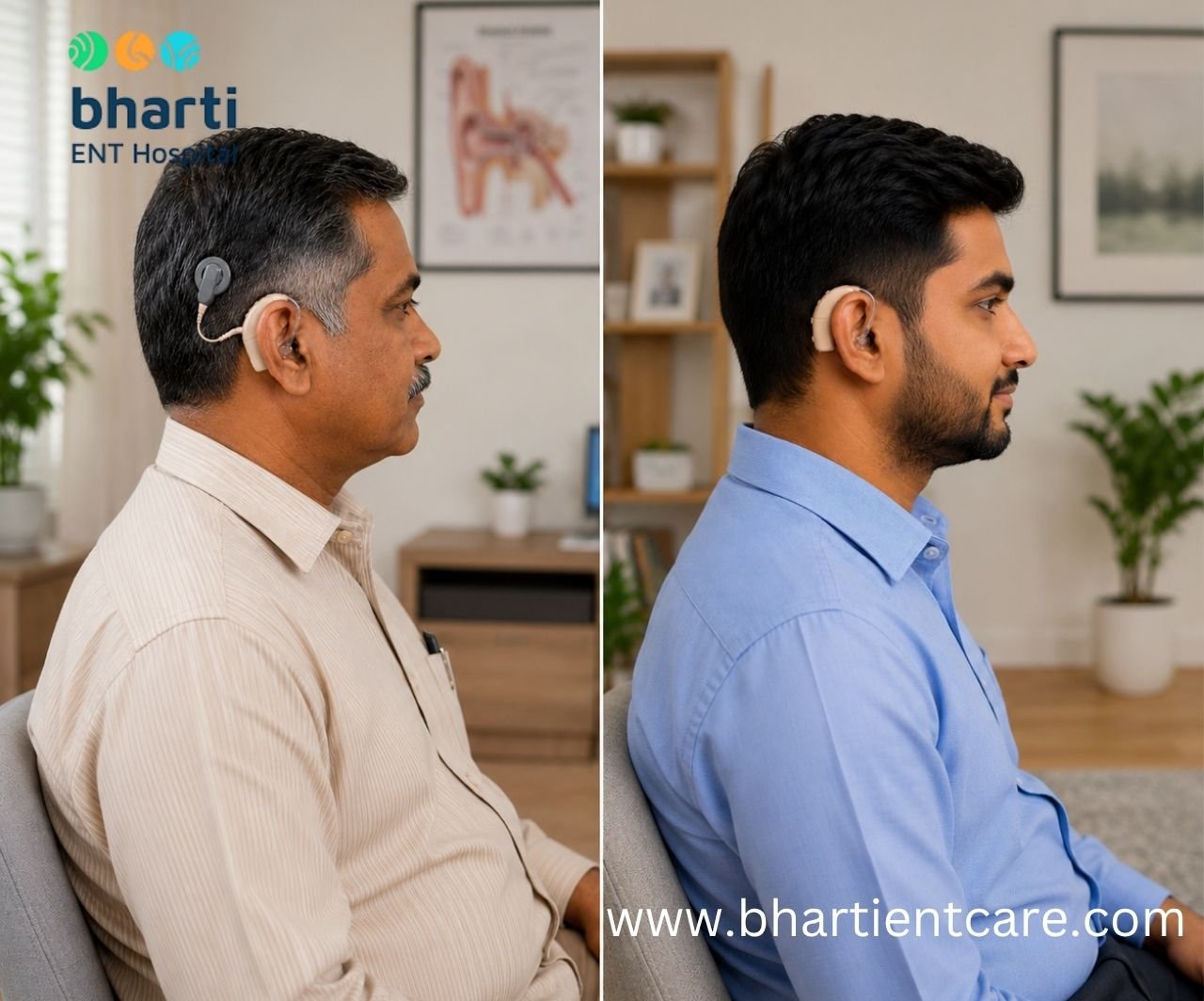
Choosing between a hearing aid and a cochlear implant can be confusing, particularly when someone has severe or profound hearing loss.
Both devices are designed to improve access to sound, but they work in very different ways. A hearing aid primarily amplifies sound, while a cochlear implant bypasses damaged sensory hair cells in the inner ear and uses electrical stimulation to activate the auditory nerve.
So, is a cochlear implant better than a hearing aid?
Not necessarily. The right option depends on the type and severity of hearing loss, how well the person understands speech with appropriately fitted hearing aids, the condition of the inner ear and auditory nerve, age, hearing history and the results of a formal cochlear implant evaluation.
For some people with severe hearing loss, a properly fitted hearing aid may provide useful hearing. For others who receive limited benefit from hearing aids, a cochlear implant may be considered.
For people in Vadodara and nearby areas, understanding this difference can help patients and families have a more informed discussion with an ENT specialist and audiologist before choosing a hearing solution.
What Is the Difference Between a Hearing Aid and a Cochlear Implant?
A hearing aid makes sounds louder, whereas a cochlear implant converts sound into electrical signals that stimulate the auditory nerve.
A conventional hearing aid contains a microphone, processor and speaker. It picks up sound, processes it and amplifies it so that the remaining functioning parts of the person’s hearing system can make better use of it.
A cochlear implant works differently. It has external components that capture and process sound and an implanted component that sends electrical stimulation to the cochlea. This allows the device to bypass damaged sensory hair cells and directly stimulate the auditory nerve.
In simple terms:
Hearing aid:
Sound → Amplification → Inner ear → Auditory nerve → Brain
Cochlear implant:
Sound → Processing → Electrical stimulation → Auditory nerve → Brain
This is why a cochlear implant is not simply a more powerful hearing aid.
How Does a Hearing Aid Work?
A hearing aid works by making sounds louder and clearer for people who still have enough functioning hearing to benefit from amplification.
Modern hearing aids can process different frequencies and adjust amplification according to the person’s hearing loss.
Depending on the type of hearing loss and the individual’s needs, hearing aids can help with:
- Conversations
- Television
- Everyday environmental sounds
- Communication in quieter environments
- Some challenging listening situations
However, simply making a sound louder does not always make it understandable.
If the sensory cells in the inner ear are severely damaged, increasing volume may provide limited improvement in speech understanding. This is one of the reasons why some people with severe-to-profound sensorineural hearing loss may eventually be evaluated for a cochlear implant.
How Does a Cochlear Implant Work?
A cochlear implant bypasses damaged sensory hair cells and uses electrical stimulation to activate the auditory nerve.
The device generally has external and internal components.
The external portion includes components such as a microphone and sound processor. The internal portion is surgically placed and contains the receiver and electrode system.
The sound processor captures sounds and converts them into coded signals. These signals are transmitted to the implanted component, which sends electrical stimulation through the electrode array inside the cochlea.
The brain then learns to interpret these electrical signals as meaningful sound.
This is why cochlear implantation is different from simply increasing the volume of a hearing aid.
Is a Cochlear Implant Better Than a Hearing Aid for Severe Hearing Loss?
A cochlear implant may be more appropriate than a hearing aid for some people with severe-to-profound hearing loss who receive little or no useful benefit from appropriately fitted hearing aids.
However, this does not mean that every person with severe hearing loss needs a cochlear implant.
The FDA describes cochlear implants as devices intended for people with severe-to-profound hearing loss who obtain little or no benefit from hearing aids.
The decision requires an individual assessment.
A person may continue using hearing aids when they provide useful access to speech and everyday sounds. Another person with a similar hearing-test result may receive insufficient speech understanding from hearing aids and could be considered for cochlear implantation.
The hearing test alone does not determine the answer.
When Is a Hearing Aid Usually Considered?
Hearing aids are generally considered when a person has enough residual hearing to benefit from amplified sound.
The type and degree of hearing loss, speech understanding, lifestyle and communication needs all influence the choice of hearing device.
An audiologist may evaluate:
- Hearing thresholds
- Speech recognition
- Speech understanding
- Hearing-aid benefit
- Communication difficulties
- Listening environments
- Previous hearing-aid use
A hearing-aid trial may also help determine how much practical benefit amplification provides.
If hearing aids provide satisfactory speech understanding and communication, continuing with hearing aids may be appropriate.
When Is a Cochlear Implant Considered?
A cochlear implant may be considered when severe-to-profound sensorineural hearing loss significantly limits hearing and appropriately fitted hearing aids provide insufficient benefit.
Candidacy is not based on hearing-test numbers alone.
The evaluation can consider:
- Degree and type of hearing loss
- Speech perception
- Hearing-aid benefit
- Duration of hearing loss
- Age
- Medical history
- Imaging findings when required
- Condition of the cochlea
- Auditory nerve status
- Communication goals
- Rehabilitation needs
Cochlear implant outcomes can also vary depending on factors such as how long a person has had significant hearing loss, age at implantation, duration of implant use and the individual’s ability to participate in rehabilitation.
This is why a proper cochlear implant evaluation is essential before making a decision.
Can Severe Hearing Loss Be Treated With a Hearing Aid?
Yes, some people with severe hearing loss can benefit from appropriately selected and fitted hearing aids, but the amount of benefit varies from person to person.
The important question is not only:
“How severe is the hearing loss?”
It is also:
“How well can the person understand speech with appropriately fitted hearing aids?”
Someone may have severe hearing loss but still obtain useful speech understanding through amplification.
Another person may struggle to understand conversations even when their hearing aids are appropriately programmed.
That difference can be important when considering cochlear implant evaluation.
What If Hearing Aids Are No Longer Helping?
If appropriately fitted hearing aids are no longer providing enough benefit, the person should undergo a hearing and ENT evaluation rather than simply increasing the volume.
Several possibilities should be considered.
The hearing aids may need:
- Reprogramming
- Repair
- New earmoulds or fitting adjustments
- Different technology
- A different hearing-aid style
Alternatively, the person’s hearing may have changed.
If hearing aids are functioning correctly but speech understanding remains poor, an audiologist and ENT specialist may discuss whether further evaluation, including cochlear implant candidacy assessment, is appropriate.
Can You Switch From Hearing Aids to a Cochlear Implant?
Yes. Some people who have used hearing aids for years may later be evaluated for a cochlear implant if their hearing loss and hearing-aid benefit meet the relevant candidacy criteria.
Using hearing aids for many years does not automatically rule out cochlear implantation.
However, the patient’s hearing history is important.
The specialist may want to understand:
- When hearing loss began
- Whether it has progressed
- How long hearing aids have been used
- How much benefit hearing aids provide
- Speech understanding with amplification
- Whether hearing loss affects one or both ears
This is particularly important when evaluating adults who have lived with hearing loss for many years.
Is a Cochlear Implant Only for People Who Are Completely Deaf?
No. Cochlear implants are not limited to people with absolutely no hearing.
Cochlear implants are primarily intended for people with severe-to-profound hearing loss who receive insufficient benefit from hearing aids, depending on the applicable device indications and clinical assessment.
Some people may retain residual hearing but still have difficulty understanding speech with conventional amplification.
Therefore, the terms “deaf” and “hearing loss” should not be used as the only criteria for deciding whether someone should be evaluated for an implant.
Does a Cochlear Implant Restore Normal Hearing?
No. A cochlear implant does not restore natural hearing, and the sound experienced through the device may initially be different from normal acoustic hearing.
The brain needs time to learn how to interpret the electrical signals produced by the implant.
Some people may develop significant improvements in speech understanding, while outcomes vary between individuals.
Factors affecting outcomes can include:
- Age
- Duration of hearing loss
- Hearing history
- Pre-existing speech and language skills
- Consistent device use
- Rehabilitation
- Individual learning ability
The FDA also notes that several factors influence cochlear implant outcomes, including duration of deafness, age at onset, age at implantation and learning support.
This is why patients should have realistic expectations rather than expecting the implant to reproduce normal hearing immediately.
Is Cochlear Implant Surgery the Only Step in the Treatment?
No. Cochlear implant surgery is only one part of the overall process.
The treatment journey can include:
- Hearing evaluation
- ENT examination
- Hearing-aid assessment
- Cochlear implant candidacy evaluation
- Imaging when clinically required
- Surgical implantation
- Healing period
- Device activation
- Programming or mapping
- Auditory rehabilitation
- Long-term follow-up
What Happens After a Cochlear Implant Is Activated?
After activation, the cochlear implant is programmed and adjusted so the patient can begin using the device and learning to interpret the new electrical sound signals.
Activation is not the same as instantly gaining normal hearing.
The patient may need time to become comfortable with the sound and develop better speech understanding.
Programming adjustments, known as mapping, may be performed over time according to the patient’s hearing experience and progress.
This is one of the most important differences between buying a hearing aid and undergoing cochlear implantation: a cochlear implant requires a longer clinical and rehabilitation journey.
Do Cochlear Implant Users Still Need Hearing Rehabilitation?
Yes. Auditory rehabilitation can be an important part of learning to interpret sound through a cochlear implant.
The brain has to adapt to the electrical signals delivered by the implant.
Rehabilitation may focus on skills such as:
- Detecting sounds
- Differentiating sounds
- Recognizing speech
- Understanding words
- Following conversations
- Improving listening in noisy environments
The amount and type of rehabilitation required varies between patients.
This is especially important for children because hearing access, speech and language development and rehabilitation can all influence communication outcomes.
Is a Hearing Aid or Cochlear Implant Better for Children?
Neither device is automatically better for every child; the appropriate option depends on the child’s hearing loss, hearing-aid benefit, age, developmental stage and cochlear implant candidacy.
Early identification of significant hearing loss is important because children are developing speech and language skills during the early years.
A child who receives useful benefit from appropriately fitted hearing aids may continue with them.
If hearing aids provide insufficient access to speech and the child meets cochlear implant candidacy criteria, an implant may be considered.
Parents should therefore avoid making the decision based solely on the hearing-test result and instead work with an ENT specialist and pediatric audiology team.
Can a Cochlear Implant Be Used in One Ear and a Hearing Aid in the Other?
Yes, in some patients, a cochlear implant may be used in one ear while a hearing aid is used in the other ear.
This approach is sometimes referred to as bimodal hearing.
Whether it is appropriate depends on the person’s hearing profile and clinical assessment.
Using a hearing aid in the non-implanted ear may allow the person to make use of residual acoustic hearing while receiving electrical stimulation from the cochlear implant in the implanted ear.
The appropriate combination should be determined by the treating ENT specialist and audiologist.
What Are the Advantages of Hearing Aids?
Hearing aids have several advantages, particularly for people who receive useful benefit from amplification.
Potential advantages include:
- Non-surgical treatment
- Easy to remove
- Different styles available
- Adjustable amplification
- No surgical implantation
- Suitable for many degrees and types of hearing loss
- Can be upgraded or replaced as needed
For someone who obtains good speech understanding with hearing aids, surgery may not be necessary.
What Are the Advantages of Cochlear Implants?
Cochlear implants can provide access to useful auditory information for appropriately selected people with severe-to-profound hearing loss who receive limited benefit from hearing aids.
Potential benefits can include improved access to:
- Speech
- Environmental sounds
- Conversation
- Everyday communication
However, outcomes vary, and cochlear implantation involves surgery, device programming and rehabilitation.
It is therefore better to think of a cochlear implant as a different hearing technology for selected patients, rather than simply a more powerful hearing aid.
What Are the Disadvantages of Hearing Aids?
The main limitation of hearing aids is that amplification may not provide sufficient speech understanding when the inner ear is severely damaged.
Other considerations can include:
- Difficulty hearing in background noise
- Limited benefit in severe-to-profound hearing loss for some patients
- Need for regular maintenance
- Battery or charging requirements
- Need for periodic programming
- Difficulty adapting to amplification in some users
However, these limitations vary significantly between individuals.
What Are the Disadvantages and Risks of Cochlear Implants?
Cochlear implantation involves surgery and carries medical risks, and the device does not guarantee a particular level of hearing improvement.
Potential considerations include:
- Surgical risks
- Infection
- Device-related complications
- Changes in residual hearing
- Need for ongoing programming
- Rehabilitation requirements
- Device malfunction or future revision
- MRI-related considerations depending on the specific implant
The FDA provides dedicated information on cochlear implant benefits, risks and MRI considerations.
Patients should discuss their individual risks with the ENT surgeon before surgery.
How Is Cochlear Implant Candidacy Evaluated?
Cochlear implant candidacy is determined through a comprehensive evaluation rather than a single hearing test.
The assessment may include:
Hearing evaluation
An audiologist measures hearing thresholds and speech perception.
Hearing-aid assessment
The team evaluates how much benefit the patient receives from appropriately fitted hearing aids.
ENT examination
An ENT specialist assesses the ears and overall medical suitability.
Imaging
CT or MRI may be recommended in appropriate cases to evaluate the cochlea, inner ear structures and relevant anatomy.
Communication assessment
Speech and language abilities may be considered, particularly for children.
Patient and family goals
The patient’s communication needs and expectations are also important.
This comprehensive approach helps the team determine whether continued hearing-aid use, cochlear implantation or another hearing solution may be appropriate.
How Does Bharti ENT Care Evaluate Patients for Cochlear Implants in Vadodara?
At Bharti ENT Care, cochlear implant evaluation can involve ENT assessment, audiological evaluation and consideration of the patient’s individual hearing needs before treatment is recommended.
Bharti ENT Care lists cochlear implantation, complete audiological setup and hearing-aid trial and dispensing among its ear-related services.
For patients from Vadodara, Gotri, Nizampura and nearby areas, this means the evaluation, surgical and follow-up aspects of the patient’s ENT care can be coordinated through the same centre.
Is Cochlear Implant Surgery Available at Bharti ENT Care in Vadodara?
Yes. Bharti ENT Care lists cochlear implant surgery among the procedures performed at its Vadodara facility.
The hospital has an ENT-focused setup that includes:
- Cochlear implant services
- Audiological evaluation
- Hearing-aid trial and dispensing
- Pediatric hearing assessment
- ENT consultation
- ENT surgery
- Postoperative care
The hospital currently lists its Nizampura facility at Kunj Centrum and its Gotri clinic on Gotri Road in Vadodara.
Patients should undergo an individual assessment rather than choosing surgery based solely on online information.
Cochlear Implant vs Hearing Aid: Quick Comparison
| Feature | Hearing Aid | Cochlear Implant |
| Basic function | Amplifies sound | Converts sound into electrical signals |
| Surgery required | No | Yes |
| Uses residual hearing | Yes | Bypasses damaged sensory hair cells |
| Typical use | Many types/degrees of hearing loss | Selected severe-to-profound hearing loss |
| Hearing-aid trial | Not applicable | Important for candidacy in many cases |
| Programming | Yes | Yes, including mapping |
| Rehabilitation | May be recommended | Often an important part of treatment |
| Can be removed? | Yes | External component can be removed; internal component remains implanted |
| Best for | People who benefit from amplification | Selected people receiving limited benefit from hearing aids |
| Decision | Audiological assessment | Multidisciplinary candidacy evaluation |
The exact candidacy criteria vary by device, age and clinical situation, so this table should be used as a general guide rather than a substitute for an evaluation.
So, Which Is Better: A Hearing Aid or a Cochlear Implant?
The better option is the one that provides the patient with the most useful access to sound and communication while being appropriate for their medical and hearing profile.
A simple decision framework is:
If hearing aids provide good speech understanding:
Continue with hearing aids unless there is another reason to consider a different solution.
If hearing aids provide limited benefit:
Consider a comprehensive cochlear implant evaluation.
If hearing loss has become progressively worse:
Have your hearing reassessed rather than simply increasing hearing-aid volume.
If a child has significant hearing loss:
Early evaluation by an ENT and pediatric audiology team is important.
If you are unsure:
Start with a comprehensive hearing assessment and discuss the results with an ENT specialist and audiologist.
There is no universal answer to “hearing aid vs cochlear implant.” The right choice is patient-specific.
Frequently Asked Questions About Cochlear Implants vs Hearing Aids
Is a cochlear implant better than a hearing aid?
Not for everyone. A cochlear implant may be more appropriate for selected people with severe-to-profound hearing loss who receive insufficient benefit from appropriately fitted hearing aids. People who obtain useful hearing with hearing aids may not need an implant.
Can a hearing aid help with severe hearing loss?
Yes, some people with severe hearing loss benefit from hearing aids. The important factor is how well the person can hear and understand speech with appropriately fitted amplification.
When should I consider a cochlear implant?
A cochlear implant may be considered when severe-to-profound sensorineural hearing loss significantly limits communication and hearing aids provide insufficient benefit. A formal candidacy evaluation is necessary.
Can you switch from a hearing aid to a cochlear implant?
Yes. People who have used hearing aids for years may still be evaluated for cochlear implantation if they meet the relevant candidacy requirements.
Does a cochlear implant restore normal hearing?
No. A cochlear implant does not recreate natural hearing. It provides electrical stimulation that the brain learns to interpret as sound, and outcomes vary between individuals.
Is cochlear implant surgery safe?
Cochlear implantation is an established surgical treatment, but like any surgery it carries potential risks. Patients should discuss their individual medical risks, expected benefits and alternatives with their ENT surgeon before proceeding.
Do cochlear implant users still need hearing rehabilitation?
Yes. Rehabilitation can help patients learn to interpret and understand the sounds provided by the implant, although the amount of support required varies.
Can children receive cochlear implants?
Yes. Children may be candidates for cochlear implantation depending on their degree and type of hearing loss, hearing-aid benefit, age, developmental factors and applicable candidacy criteria. Early hearing evaluation is particularly important for speech and language development.
Can I use a hearing aid with a cochlear implant?
Yes, in some cases. A person may use a cochlear implant in one ear and a hearing aid in the other, depending on their hearing profile and clinical recommendations.
Where can I get a cochlear implant evaluation in Vadodara?
Bharti ENT Care in Vadodara provides cochlear implant services alongside audiological assessment and ENT care. Its listed specialist team includes ENT specialists and an audiologist.