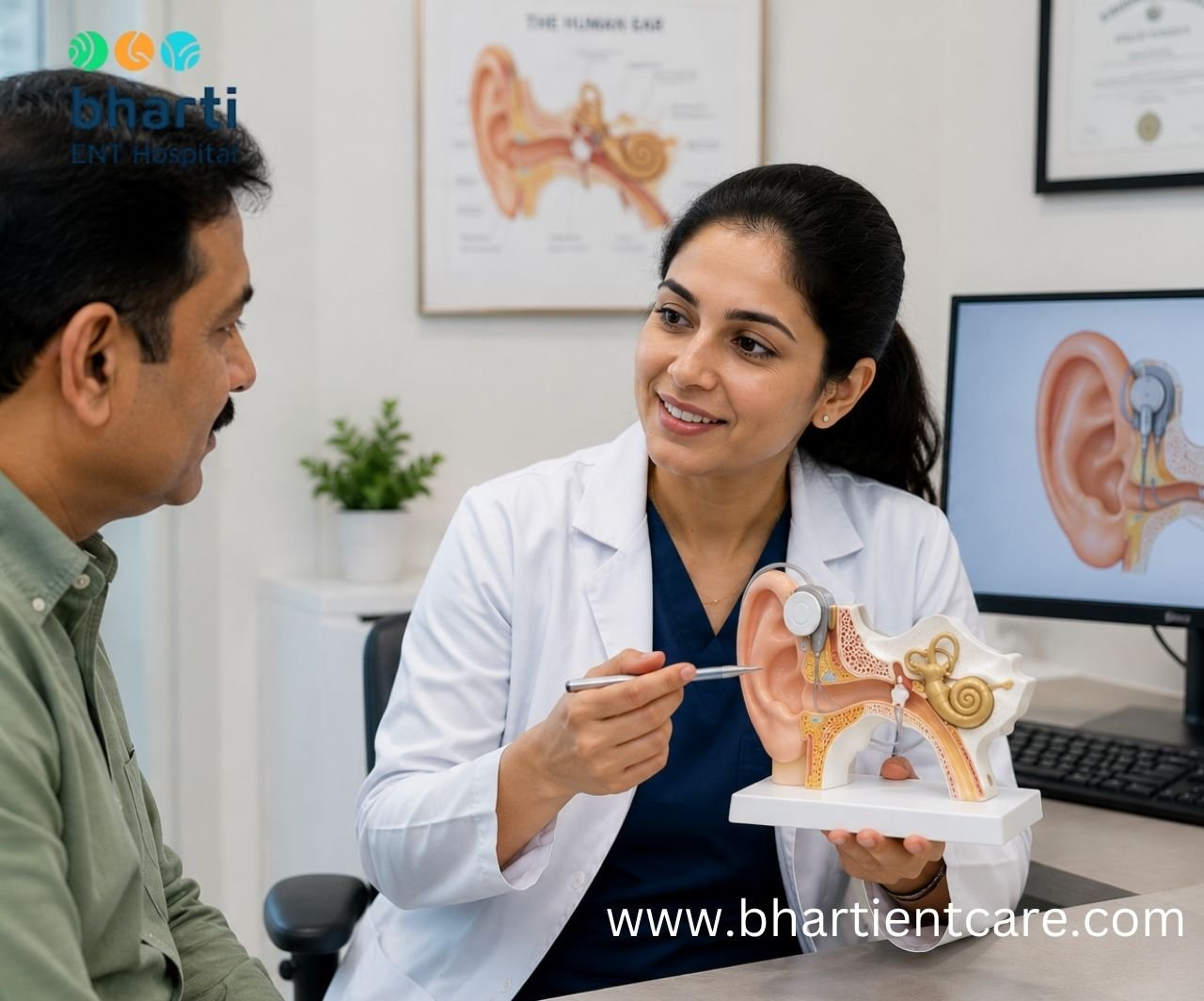
Very loud sounds can impact communication, emotional state, learning ability, and social self-assurance. Hearing implants could be a good long-term solution for people who are not benefiting from hearing aids. Bharti ENT Hospital has a team of experts performing hearing implant surgeries with the aim of restoring hearing and enhancing the communication skills in children and adults alike.
A hearing implant is an advanced medical device that is intended to assist people who have severe to profound sensorineural hearing loss. Cochlear implants are a different type of hearing device, which are not just designed to amplify sound but also bypass the damaged parts of the inner ear and directly stimulate the hearing nerve. This enables sounds to be heard and processed better.
The factors that contribute to a successful cochlear implant surgery are patient age, hearing history, overall ear health, timing of the surgery, and post surgery rehabilitation. Successful implantation often results in better speech understanding, more awareness of the environment’s sounds, and better communication skills.
With the modern implant systems, the sound processing technology is constantly evolving and hearing rehabilitation is now more effective than ever. That said, it is important to have realistic expectations and follow-up treatment as part of the long-term success.
How Cochlear Implants Work?
There are two parts to a cochlear implant: the external sound processor and an internal implant that is surgically inserted under the skin. The external processor picks up sounds in the environment and translates them into digital signals. The signals are then sent to the device that is implanted, which directly stimulates the auditory nerve.
This procedure helps the brain to decode auditory messages, enabling patients to better understand speech and background noises. Cochlear implant hearing is different from natural hearing, in that the brain needs to slowly adjust to the new way of hearing by practicing listening and undergoing rehabilitation.
Typically, the procedure is advised for people who have severe hearing loss and do not notice much improvement from using hearing aids. Before surgery, candidates are normally subjected to in-depth hearing, imaging tests, speech evaluation and ENT tests.
Treatment for hearing implants typically consists of several steps:
- Comprehensive hearing evaluation
- Assessment for Cochlear Implant candidacy
- Surgical implantation procedure
- Activating devices after healing
- Auditory rehabilitation and speech therapy
- Long-term hearing monitoring
ENT and audiology centres may have integrated services for cochlear implants, including hearing diagnostics, surgical planning, implant programming and rehabilitation for children and adults with advanced hearing loss. It is important to remember that the hearing improvement will not be immediate after activation, by the patient and family. It takes time for the brain to adapt to the new hearing signals and over time, listening and speech understanding are gradually developed through regular therapy sessions.
How Successful Are Cochlear Implants?
For suitable candidates, cochlear implants have been highly successful at enhancing hearing and communication skills. Treatment results in significant improvements in speech recognition, conversation clarity, educational participation and social interaction in many patients.
Young children who receive implants are more likely to develop better speech and language skills because the developing brain will better adjust to sound input. Early diagnosis and early implantation are particularly essential for speech and learning results.
Adults with acquired hearing loss can also receive great benefit, especially if they have had normal hearing prior to the hearing loss. The ability to recognize speech patterns is already being learned by the brain and so adaptation to sound processing via the cochlear implant is easier in many cases.
After successful implantation, some common benefits reported include the following:
- Improved speech understanding in quiet settings
- Improved awareness of surrounding sounds
- Enhanced communication confidence
- Reduced listening effort
- Improved social interaction
- Improved educational and work engagement
There is a difference in success rates from one person to another. Outcomes vary by the length of time someone has had hearing loss, the health of the nerves, if one attends rehabilitation, and how consistently they use the device. Although implants can’t give you the same hearing you had before, for many people with severe hearing loss, they provide better access to sound and communication.
Recovery and Rehabilitation After Implant Surgery
After the hearing implant surgery, there is a brief recovery period before the implant is activated. Most patients go home within 1-2 days of surgery, depending on their overall health and surgical condition.
Once healed, the external processor is fitted and programmed to the patient’s hearing response levels. This process is known as mapping or device programming. Multiple follow-up sessions may be needed to adjust sound settings for optimal hearing performance.
Rehabilitation is a critical success factor for implant. The brain has to learn to understand the new sounds that have been received, particularly for a person who has a chronic hearing loss. Auditory training and speech therapy sessions enable patients to identify speech patterns, enhance their listening capacity, and enhance communication skills.
Patients recovering from implant procedures are usually advised to:
- Participate in regular mapping sessions
- Practice listening exercises daily
- If recommended, attend speech therapy sessions
- Adhere to post-surgical precautions carefully
- Don’t miss follow-up appointments
Care for a cochlear implant frequently involves an integrated program of ENT surgery, hearing diagnostics, speech rehabilitation, and long-term hearing monitoring for improved outcomes. Educating families about common myths around cochlear implants is a vital element to helping them make informed decision making choices regarding hearing care.
Factors That Influence Implant Outcomes
The success rate of cochlear implants is very high in many people, but there are variations in individual and medical factors. This knowledge will help to keep patients and families in check during treatment so they have realistic expectations.
Age at Implantation
Children who are implanted at an early age will have better speech and language development as the brain adjusts quickly in early developmental years.
Duration of Hearing Loss
People who have experienced hearing loss for a shorter amount of time may show quicker adaptation to a hearing implant than individuals with a longer history of untreated hearing loss.
Consistency of Device Use
The implant gets stronger with time and helps the brain get better at recognizing sounds and communication skills on a daily basis.
Rehabilitation Participation
To optimize hearing after implantation, speech therapy, auditory training and follow-up programming sessions are essential.
Overall Ear and Nerve Health
The outcome of a successful hearing relies on the health of the auditory nerve and the ability of the patient to effectively process sound signals.
For those interested in more advanced hearing restoration procedures, they may consider the best ENT hospital in Vadodara to conduct a thorough assessment, surgery, rehabilitation, and follow-up for their patients.
Long-Term Benefits of Hearing Implants
The effects of hearing implants go beyond an improvement in hearing. Successful rehab often allows many recipients to become more independent, gain social confidence, enjoy better educational opportunities, and have better emotional well-being. Better access to hearing for children helps support speech development, classroom participation and communication growth in the years when they are most critical.
Adults may have more successful conversations, less listening fatigue and better workplace communication following adaptation to the implant. Families have emotional benefits, too, when communication flows more easily and naturally in everyday life. Long-term implant performance and hearing quality are maintained with regular hearing monitoring and device maintenance.
The advanced hearing implant services provided at Bharti ENT Hospital are backed by specialized evaluation, surgical expertise, hearing rehabilitation, and post-surgical support. They collectively aim at providing patients with the best hearing outcomes and improved quality of life through structured and personalized hearing management.
Frequently Asked Questions (FAQs)
Who is the ideal candidate for cochlear implant surgery?
It is typically recommended for people who have severe hearing loss and do not benefit from hearing aids.
Which services are provided in cochlear implant treatment at Bharti ENT Hospital?
Services involve hearing assessment, candidacy evaluation, surgery, implant programming and rehabilitation therapy.
What is the recovery time after implant surgery?
Recovery is usually complete in a few weeks, and hearing rehabilitation can be a gradual process following activation of the device.
Do children need speech therapy post-cochlear implantation?
Yes, speech and auditory therapy can be useful in enhancing listening skills and speech understanding following implantation.