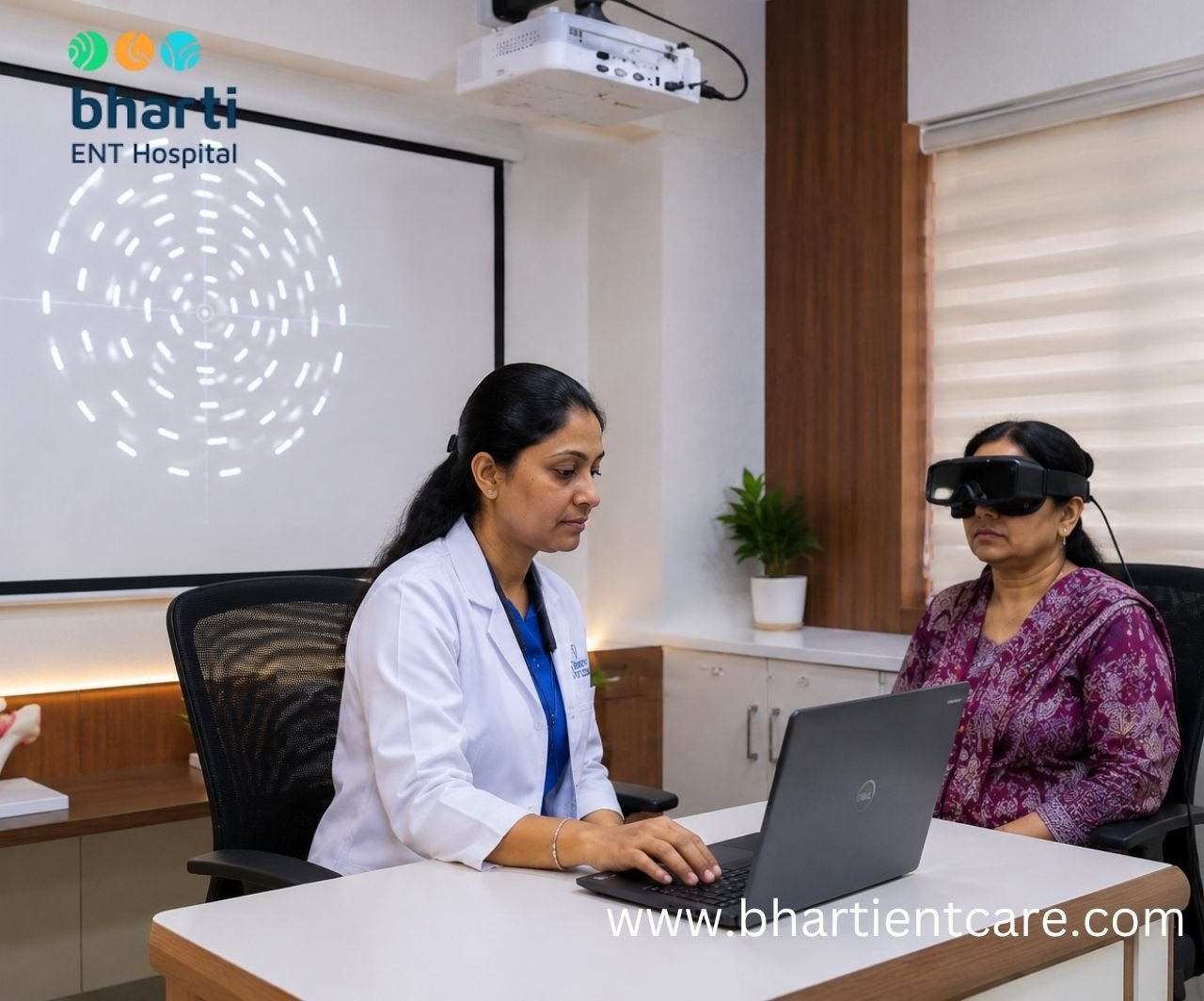
The vertigo test is NOT a single test. The diagnosis of dizziness or vertigo is made with the help of a combination of medical history, physical examination, eye-movement assessment, positional tests and, if needed, even vestibular testing or imaging.
Vertigo is a feeling of the body or outside world rotating, spinning or moving when there is no real movement. The terms vertigo and dizziness are often confused, but dizziness can refer to several different sensations including light-headedness, imbalance or a spinning sensation.
It is important because the causes of dizziness are different for various types of dizziness.
For instance, if the episodes of spinning last only a few seconds when moving the head, this could indicate benign paroxysmal positional vertigo (BPPV) and if the dizziness is accompanied by any hearing loss or tinnitus, evaluation of the inner ear may be necessary. In other cases, neurological symptoms might signify that something other than the inner ear is at fault.
A test of the inner ear’s balance system is a type of vestibular testing that may help the physician determine whether the dizziness is caused by a problem in the inner ear or some other neurological disorder.
The crucial question for those looking for a vertigo test in Vadodara isn’t just “Which test is the best option? It is:
What test should I ask for if I feel a certain way and what is the doctor looking for?
For what reasons do doctors run tests for Vertigo?
A vertigo test and balance test are performed by doctors to determine if symptoms are due to the inner ear, the vestibular system, the brain or other medical issues.
Your balance relies on information from several systems: eyes, muscles and joints, and the vestibular organs of the inner ear. These signals are integrated by your brain to assist with determining your body’s spatial position and its movement.
If any component of this system fails, you can suffer from:
- Spinning sensations
- Dizziness
- Unsteadiness
- Problems walking
- Motion sensitivity
- Nausea
- Difficulty maintaining balance
Symptoms caused by the movement of the head.
A battery of vestibular tests can be used to evaluate the reaction of the balance system of the inner ear to various movements and stimuli. It may be beneficial if symptoms indicate BPPV, labyrinthitis, Ménière’s disease and/or vestibular neuritis.
But vestibular testing is just one step in the diagnostic process. Your doctor may need to take into account your medical history, examination and symptoms as well as test results to make a diagnosis.
What tests do doctors order to determine what caused the vertigo?
Doctors make a diagnosis of vertigo by gaining an understanding of the patient’s symptoms and selecting examinations or tests that match the pattern of dizziness, its duration and its triggers.
As part of an ENT or vestibular appointment, the doctor might ask you:
- At what time did you begin to feel dizzy?
- Is the room spinning or rocking?
- What is the duration of each episode?
- Does rotating your head cause it to start?
- Do the symptoms get worse when you stand?
- Have any hearing loss?
- Have you ever had the feeling of ringing, buzzing or hissing noises in the ears?
- In the past few days, have you been unwell with a viral infection?
- Are you getting a headache or visual symptoms?
- Have you vomited or had extreme nausea?
- Ever experienced any other episodes of vertigo?
This information can be very helpful.
If, for instance, the vertigo only lasts for a few seconds and is caused by moving the head, it may indicate BPPV, whereas if the vertigo persists and there are other neurological symptoms it may indicate a different diagnosis.
The doctor may then conduct positional testing, assess eye movement, test hearing and balance, and/or refer the patient for additional vestibular testing.
Dix-Hallpike Test: What is it?
The Dix-Hallpike maneuver is a position test frequently used to diagnose posterior-canal BPPV, which is a frequent cause of short duration positional vertigo.
The healthcare professional adjusts the head and body position during the test, and looks for nystagmus, a type of involuntary eye movement.
The test may temporarily create the patient’s spinning sensation.
The typical exam will include:
- The patient is sitting up.
- The doctor rotates the head on the side.
- Patient is slowly shifted back into supine position.
- The doctor can see how the patient’s eyes move.
- The maneuver could be repeated on the other side.
Having a positive response can help make a diagnosis of BPPV. The Epley maneuver is a treatment for certain types of BPPV, whereas the Dix-Hallpike maneuver is a diagnostic test.
According to the doctors, the test is safe, but doctors may adjust or skip the test for patients with some neck or back conditions or motion that might put them at risk.
What is VNG Test for Vertigo?
A vestibular test where a specialized pair of videonystagmographic goggles records eye movement that also measures portions of the balance system, is called videonystagmography or VNG.
The eyes give a great deal of information regarding the characteristics of the vestibular system. While VNG, the patient’s eye movements are measured during various tasks.
VNG may consist of:
- Eye-movement testing
- Visual tracking tasks
- Positional testing
- Head and body position changes.
- Caloric testing
When the calorie test is performed, warm or cool air or water is poured into the ear canal, and eye movements are recorded. The answer gives you details regarding the vestibular function.
If a person has one or more of these symptoms, they might want to have a VNG test:
- Recurrent vertigo
- Dizziness
- Imbalance
- Feeling that the surroundings are spinning
- Some symptoms of hearing or ear problems
The results of a VNG do not give a definitive diagnosis. The results should be carefully evaluated in the context of the patient’s symptoms and other examination findings.
What is a Vestibular Test Battery?
A vestibular test battery is a collection of tests that assess various parts of the inner-ear balancing system, instead of one test.
Not all vestibular tests are necessary in all patients.
Tests are chosen by the doctor or audiologist depending on the patient’s symptoms and the clinical query being asked. Vestibular testing evaluates the functioning of the inner ear, eye movements and brain coordination to maintain balance.
Depending on the patient, the tests may consist of:
VNG
Measures eye movements in various visual, positional and vestibular activities.
Dix-Hallpike maneuver
Used to evaluate for a typical form of BPPV.
Caloric testing
Applies stimulation to the ear to measure the response from the inner ear.
Rotary-chair testing
Assesses the eyes’ and the vestibular system’s reaction to rotation on a motorized chair.
Other vestibular assessments
Other tests may be performed to help diagnose the disorder, including video head impulse testing and vestibular-evoked myogenic potentials.
The key is that there is no universal “one size fits all” vertigo test.
What Does a Caloric Test Test For Vertigo?
A caloric test examines how the vestibular system reacts to stimulation of the ear using warm or cool air or water, and then observing eye movements in response.
The test takes advantage of the connection between the vestibular organs and eye movements.
However, ear canal temperature changes during testing can activate the balance system. The eye movements are then recorded and analyzed.
Caloric testing can be part of a VNG or a comprehensive vestibular examination.
May assist the specialist in determining if there is a difference between the two sides of the vestibular system.
The test will stimulate the balance system, which may cause temporary dizziness or nausea for the patient. This feeling tends to fade away once the stimulation ceases.
Is a Hearing Test useful for Diagnosing Vertigo?
A hearing test is not a definitive diagnosis of all causes of vertigo but when vertigo is accompanied by hearing loss, tinnitus, or other ear symptoms, hearing assessment can be useful and provide valuable information.
The inner ear is where hearing and balance are also housed. Certain disorders may involve one system or more than one system.
So, a person who has symptoms of vertigo and:
- Hearing loss
- Tinnitus
- Ear fullness
- Pressure in the ear
- Changes in hearing
The overall evaluation may include a hearing evaluation for may.
The findings can assist the ENT specialist in determining whether the dizziness might be related to an ear problem or if additional vestibular and/or neurological work is warranted.
A full ENT and audiology examination may be helpful in patients who experience recurrent dizziness and may be one reason.
Should one have an MRI for Vertigo?
An MRI is not necessary for all people with vertigo. Usually imaging is ordered when signs and symptoms, examination, or history point to a neurologic or structural origin that needs to be further evaluated.
In many cases, for instance, BPPV, a clinical history and positional testing can make the diagnosis without the use of brain imaging. In typical BPPV presentation, MRI or CT is typically not needed, Johns Hopkins said.
When there are some concerning features, however, imaging might be warranted.
These can include:
- New neurological symptoms
- Neurological exam abnormalities:
- In progressive or asymmetric hearing loss the loss of hearing is gradual and uneven.
- High blood pressure, high cholesterol, diabetes, obesity, smoking, and overweight.
- Suspicion for central neurologic cause
- Other atypical features
If imaging is indicated for vertigo, MRI is preferred for most of the causes of posterior-fossa and inner-ear/brain-related processes, since it can visualize these areas.
This should always be determined by the treating doctor’s clinical picture.
What Is a Positive Vertigo Test?
If the vertigo test is positive, it means that the test has returned positive results, which would be consistent with the condition which the test is designed to assess, not that all other causes of dizziness have been ruled out.
For instance, a positive Dix-Hallpike test can help diagnose BPPV if the symptoms of vertigo and nystagmus are noted.
VNG results can also show abnormal vestibular/eye-movement responses, just as with the other tests, but results should be considered in the context.
This is essential as sometimes patients are looking for “positive vertigo test meaning”, and they want a yes or no answer.
As a matter of fact the doctor thinks:
The doctor will perform a physical exam, ask about the symptoms, review the test results, ask about the person’s medical history, and do additional tests.
Before making a diagnosis.
What Does a Negative Vertigo Test Mean?
A negative test for vertigo does not rule out the absence of any problem; it may just mean that the problem being tested for by that vertigo test was not shown.
For instance, if the Dix-Hallpike test is negative, it decreases the possibility of posterior-canal BPPV, but the doctor may order other positional tests or consider other causes based on the symptoms.
Even if a patient has no underlying Meniere’s disease, they may experience dizziness from another vestibular problem, neurological condition, medication or other medical problem.
That is why it is important not to view a given test alone.
What is the duration of Vertigo Test?
Length of time varies according to the test. The actual time required for a thorough assessment of the vestibule is much longer and a simple positional exam may only take a few minutes.
Dix-Hallpike manoeuvre is one of these tests and is relatively quick to perform in an office setting.
A VNG exam, however, may last 1 hour, depending on the protocol and tests performed.
A wider evaluation of the vestibule may take longer, if several tests are needed.
The patient should therefore request the clinic’s appointments and if they need to be accompanied home.
Does a Vertigo Test hurt?
Some tests are designed to specifically put the balance system under stress and cause dizziness, nausea or imbalance, and most of the other tests are non-invasive.
The Dix-Hallpike test for example, can cause the spinning sensation of BPPV for a few seconds.
Likewise, some patients experience dizziness or nausea with VNG and caloric testing.
This does not imply that there is a problem. The symptoms may be included as part of the test.
Patients should however, report any extra or unusual symptoms they may experience while being tested.
Vestibular Testing – How To prepare?
Each test is different, so patients should not discontinue medications or alter their diet without direction from their ENT specialist or audiologist.
The clinic might give directions about:
- Certain medications
- Food and drink
- Alcohol
- Eye makeup
- Transportation after the test
The testing centre may provide information on whether some medications should be temporarily discontinued as they can affect the results from the vestibular testing. Prescribed medication should never be discontinued without the patient’s doctor’s advice.
Cleveland Clinic also points out that patients may experience dizziness following the vestibular testing and could be advised to arrange transportation home.
What is a Vertigo Test Used To Diagnose?
Various vertigo and vestibular tests may be used to help your doctor determine the cause of your vertigo, like BPPV, vestibular neuritis, labyrinthitis, and Ménière’s disease or other balance disorders.
But there are no single tests to diagnose all the conditions of the vestibule.
Examples include:
BPPV
Typically comes with short attacks of positional vertigo. Positional testing (like Dix Hallpike maneuver) may be helpful.
Vestibular neuritis
May precipitate acute and persistent vertigo and instability and may necessitate a combination of clinical evaluation and vestibular testing.
Labyrinthitis
May lead to vertigo/dizziness and to hearing symptoms.
Ménière’s disease
May include episodes of vertigo along with hearing changes, tinnitus and ear fullness.
Other vestibular disorders
Further tests may be required if the symptoms do not align with a typical pattern.
The objective is not just to make a diagnosis of “vertigo. The purpose is to find out what is causing the vertigo.
When to visit an ENT for Vertigo?
If the vertigo occurs frequently, every day, is causing problems with hearing or ear symptoms, or is persistent in nature, consider an ENT exam.
A consultation will be very helpful if dizziness is recurring and not easily understood.
If you have any of these symptoms, it may be worth visiting an ENT:
- Repeated spinning episodes
- Headaches, especially when turning head to the side
- Unexplained imbalance
- Vertigo with loss of hearing.
- Tinnitus with dizziness
- Recurrent vertigo and fullness of the ears.
- Vertigo following an ear infection.
- Persistent dizziness
- Difficulty walking because of balance problems
An ENT specialist can make a determination if symptoms seem to be coming from the ear and vestibular system or if you need to have another medical evaluation.
When is Vertigo an Emergency?
If there are new neurological symptoms, severe difficulty walking, weakness, numbness, problems with speech, severe headache or any other symptoms of concern, then it’s time to seek urgent medical evaluation.
Not all dizziness requires emergency treatment. One such peripheral cause of short-term positional vertigo is known as BPPV.
However, there are times when dizziness is a symptom of a severe neurological disorder.
If vertigo develops along with the following symptoms get emergency medical help right away:
New weakness in the arm or numbness in the arm.
- Difficulty speaking
- Facial weakness
- New severe headache
- Significant difficulty walking
- Double vision
- Loss of consciousness
- New severe neurological symptoms
The Johns Hopkins Hospital identifies neurological deficits and other characteristics that indicate a central cause as indications for further evaluation and perhaps imaging.
Does an ENT Doctor diagnose Vertigo?
Yes. A specialist of ENT can assess many of the most common causes of vertigo, such as problems with the inner ear and the vestibular system.
An ENT examination may include a detailed history, ear examination, hearing assessment, positional testing and if appropriate, vestibular testing.
In more complicated situations the ENT may collaborate with other specialists such as an audiologist, neurologist, radiologist or other physician according to the suspected etiology.
The key point is that vertigo itself is not a disease; it is a symptom.
The purpose of the consultation is to find out what is causing the dizziness, therefore not just to prescribe a dizziness remedy.
What are the methods of treating Vertigo at Bharti ENT Care in Vadodara?
Bharti ENT Care has a dedicated Vertigo Clinic and offers diagnosis/evaluation services as a part of its complete ENT care.
The specialist team includes Dr. Bhavin Parikh (ENT and Head & Neck Surgery) and Dr. Unnikrishnan Nair (ENT Surgeon). The centre also has Mr Miraj Shah listed as the audiologist.
In the case of a patient with dizziness or vertigo, the examination should involve testing for the patient’s specific symptoms and not by default, every test in the book.
Treatment typically involves:
1. Understanding the symptoms
The doctor will identify if the patient is reporting true spinning vertigo, lightheadedness, imbalance or some other sensation.
2. Identifying triggers
The team should ask the following questions: Do symptoms happen when:
- Turning in bed
- Looking upward
- Bending down
- Standing up
- Walking
- Moving the head
- Being exposed to visual motion
3. Ear checking and hearing
If ear symptoms are present with dizziness, then an ear examination and hearing assessment might be warranted.
4. Carrying out positional or vestibular tests
Positional testing or more detailed vestibular testing may be necessary depending on the clinical suspicion.
The need to decide if there is a need for further investigation.
If symptoms indicate a neurological or structural problem that may be affecting the ear, the doctor may recommend further medical testing or imaging instead of treating it as a problem of the inner ear.
Bharti ENT Care works on the principles of Consultation, Investigation, Treatment and Post Treatment Care under one roof and Personalized Consultation depending on the concern.
Common Questions on Vertigo Tests
Which is the most reliable test to assess vertigo?
No single best test for all forms of vertigo. The test used will vary according to the symptoms and suspected cause. Positional testing may be helpful in BPPV and various forms of vestibular testing may assess various components of the balance system such as VNG.
What test confirms BPPV?
The Dix-Hallpike maneuver is commonly used to diagnose the typical form of BPPV. The clinician looks for the characteristic vertigo and nystagmus produced by the positional change.
Do people with vertigo have VNG tests done?
Yes. VNG is a vestibular test to assess eye movement and components of the vestibular system in individuals with dizziness and vertigo.
Should I have an MRI for dizziness or vertigo?
Not always. Brain imaging is typically not necessary for typical BPPV, but may be considered in cases where symptoms and/or examination findings suggest a neurological or structural cause.
Is there a blood test that can be used to diagnose vertigo?
There is no blood test that can be used to diagnose most common causes of inner ear vertigo. A blood test may be ordered if a doctor thinks that another health problem may have led to dizziness.
Does a vertigo test hurt?
Vestibular tests are non-invasive, except for some tests that, when stimulated or challenged the balance system, may induce a temporary feeling of dizziness or nausea.
What is the duration of VNG?
A VNG test can last for approximately an hour, depending on the protocol for the test. The actual duration that is expected will be available at your testing centre.
Is vertigo diagnosed by an ENT doctor?
Yes. An ENT specialist can examine a variety of causes of vertigo, particularly, disorders affecting the inner ear and the vestibular system. If symptoms point to a neurological or other cause, further specialist evaluation may be required.
Can hearing loss and vertigo be related?
Yes. There are some internal ear diseases that affect both ears, the inner ear and the ear that helps with balance. If there are also symptoms of hearing loss, tinnitus and/or ear fullness, hearing and vestibular testing may aid in determining the cause of the vertigo.
Can hearing loss and vertigo be related?
Yes. There are some internal ear diseases that affect both ears, the inner ear and the ear that helps with balance. If there are also symptoms of hearing loss, tinnitus and/or ear fullness, hearing and vestibular testing may aid in determining the cause of the vertigo.