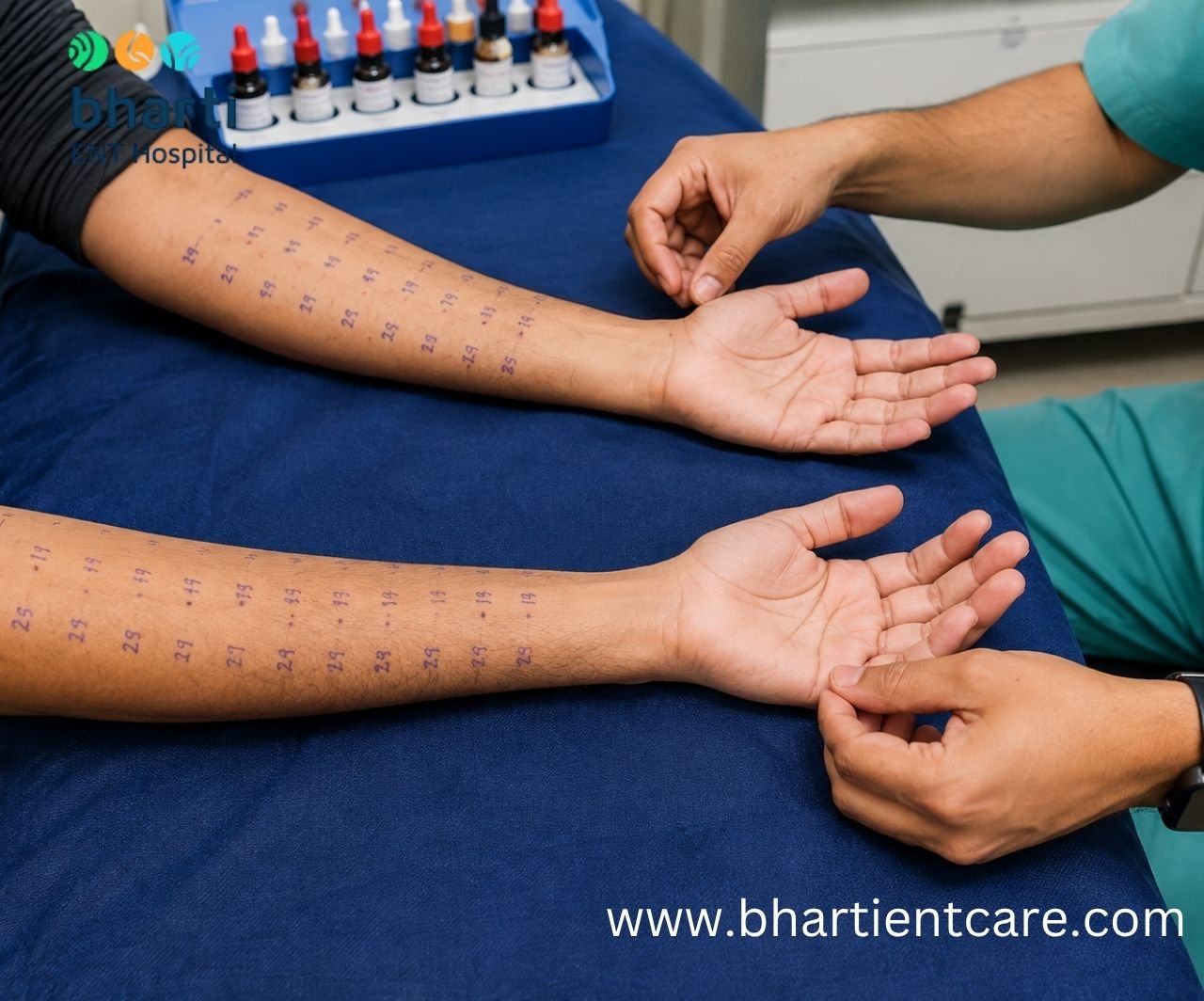
Allergy skin prick test is a diagnostic test that can be done to see if a person is sensitised to any of the allergens that may be causing the symptoms.
In the test, samples of the chosen allergen extracts are applied to the skin, typically the forearm or upper back. The skin is then superficially pierced to allow the allergen to penetrate the top layer of skin.
A small raised itchy area (wheal) may appear at the testing site with redness (flare) if the person is sensitised to the allergen.
The use of skin prick testing is widespread as it can give information on IgE-mediated allergic sensitisation relatively quickly. But if someone’s skin reacts positively to the test, it isn’t necessarily caused by the allergen if the individual has other symptoms. Test results should be evaluated in conjunction with the patient’s symptoms and medical history.
For those who suffer from repeated:
- Sneezing
- Runny nose
- Nasal congestion
- Itchy nose
- Watering or itching of eyes
- Post-nasal drip
- Allergic cough.
Symptoms that get worse when exposed to dust, pollen, mould or other possible causes
Why Do Doctors Recommend an Allergy Skin Prick Test?
A skin prick allergy test may be ordered if a person’s symptoms are consistent with an allergic reaction and it’s important to know what is causing the allergy to help treat or avoid the allergen.
For instance, a person might find that their nose gets blocked or they begin sneezing a lot of the time when they come into contact with dust, at specific times of the year or at specific environmental triggers.
Allergy testing is not a test to assume the trigger but can be used to determine the triggers of allergies if the immune system is sensitised to them.
Allergy testing for some common allergens can include:
- House dust mites
- Pollens
- Moulds
- Animal dander
- Cockroach allergens
- Certain foods
- Other environmental allergens
Specific allergens will vary based on the symptoms of the patient, the history of their exposures and the testing procedure the healthcare provider used.
The American Academy of Allergy, Asthma & Immunology (AAAI) states that allergy testing should be chosen to fit the clinical context of the patient’s history, and not used as a standalone diagnosis.
What is an Allergy Skin Prick Test?
Small amounts of allergen extracts are placed on the skin during an allergy skin prick test to see if there is an allergic skin reaction at the site.
The general procedure is quite simple.
Step 1: The doctor reviews your symptoms
The doctor will typically ask about the following before testing:
- Your symptoms
- How long they have been present for
- When they occur
- Possible environmental triggers
- Seasonal changes
- Previous allergic reactions
- Medicines you take
- Previous allergy tests
- A family history or personal history of allergy.
This information is useful to decide which allergens should be tested.
Step 2: Receiving area is set up for testing
It is generally given on the forearm or upper back.
Various allergen extracts are applied in different places and each reaction is attributed to a specific allergen. According to AAAAI guidelines, prick testing may be done on either the upper back or the volar forearm and care must be taken to make sure that test sites are spaced apart.
Step 3: Gently prick the skin
A tiny sterile device is inserted into the skin at every drop of allergen.
Superficial and does not inject a lot of allergen.
Step 4: a look is taken at the skin.
The appropriate waiting period is completed and the health care professional checks for reactions at the test sites.
Step 5: Results are interpreted
Size and appearance of the reaction are documented and analyzed in conjunction with the patient’s history and symptoms.
Test result is not a standalone result.
What does a Positive Allergy Skin Prick Test mean?
If the skin prick test is positive, it usually means sensitisation to the allergen that was tested, but it does not necessarily mean that the allergen is responsible for the patient’s symptoms.
One of the most significant things an allergy patient should know about allergy testing is that it will merely help them determine whether their condition is triggered by a specific allergen.
Imagine someone experiences year round sneezing, nasal congestion and tests positive for dust mites.
This finding can help confirm the diagnosis of dust-mite allergy if the person’s symptoms and exposure history are consistent.
The doctor still has to take into account the overall clinical situation, however.
The positive test can therefore be interpreted as:
The immune system has shown an allergic sensitisation to that particular allergen.
Not necessarily implies:
This allergen causes all of your symptoms.
This separation reduces unnecessary avoidance of foods, pets/environmental substances because of a test result.
A negative allergy skin prick test means that you are not allergic to the specific allergen tested.
A negative skin prick test indicates that the allergen tested could not be expected to cause a skin reaction and, therefore, sensitisation to that allergen is less likely.
But the negative test result doesn’t necessarily mean there’s no explanation for the symptoms.
Possible reasons include:
- The actual trigger was not included in the test.
- The symptoms could be caused by another condition.
- Symptoms could be a non-IgE mediated allergy.
- Some medications may affect the response of the skin.
- Another diagnosis may be suspected in the course of the patient’s history.
A doctor might suggest further evaluation if allergy tests are negative but symptoms persist.
What Allergens Can be Tested by a Skin Prick Test?
A skin prick test can be used to test sensitisation to various environmental and, if clinically indicated, food allergens.
The specific panel should be ordered based on the patient’s history and not solely because of the scope of testing.
Common environmental allergens can include:
- Dust mites
- Grass pollen
- Tree pollen
- Weed pollen
- Mould
- Animal dander
- Cockroach allergens
Selected foods may be considered food allergens if a food allergy is suspected.
The decision will depend on the symptoms and possible exposure to the patient.
For instance, the person with chronic nasal allergy symptoms might require testing based more on inhaled allergens, while the person with a possible food reaction would be directed towards different clinical evaluations.
Is a skin prick test able to diagnose allergy to nasal allergy?
Yes, skin prick testing can be helpful in determining whether someone is sensitised to an allergen if he or she has symptoms that are typical of allergic rhinitis (sneezing, runny nose, nasal congestion).
Airborne allergens, including pollen, dust mites, mould and animal dander can cause nasal allergies (allergic rhinitis).
If symptoms come back the next time, and the physician feels it may be an allergy, then testing can be useful in determining what triggers may be of concern.
For example:
Sneezing, nasal congestion, symptoms with dust, positive dust mite skin test (repeatedly)
may be helpful in supporting dust-mite allergy.
The test result, however, must not be used as the only factor in interpreting the test result and should be used in conjunction with the patient’s history.
Does an Allergy Skin Prick Test hurt?
An allergy skin prick test is usually very little invasive, though the patients may feel a prick, itching or minor pain at the spots that respond.
The test is designed to generate a local response.
If an allergen has sensitised the person, the corresponding site may be:
- Itchy
- Red
- Slightly swollen
- Raised
The chemical reaction typically is confined to the area being tested.
The procedure is not the same as an injection where the allergen is injected into the muscle.The procedure is not the same as an injection where the allergen is injected into the muscle, it is only being introduced superficially through the skin prick.
What is the duration of Allergy skin prick test?
The actual time spent on skin testing is fairly brief, but the entire appointment may be longer since the doctor must spend some time talking with the patient about the symptoms, choosing the appropriate allergens, and interpreting the results.
This test consists of applying multiple allergen extracts to the skin, prick-superficial and recording the skin reaction.
- The length of time will depend on:
- Number of allergens being tested
- Testing method
- Patient’s age
- Medical history
- Number of symptoms being assessed.
- The need for further examinations
The patient should make sure to inquire from the testing centre as to how long they should expect to stay at the clinic.
What to Expect on an Allergy Skin Prick Test?
The dosage of meds you use and the testing protocol will determine the preparation required, so patients should refer to their doctor or testing centre.
Antihistamine drugs are one of the most important factors to take into account.
Patients should not discontinue conventional or prescription medications without consulting their physician, however.
Tell your doctor before the test about:
- Antihistamines
- Allergy medicines
- Antidepressants
- Other regular medicines
- Skin creams/corticosteroids
- Severe allergic reactions that occurred in the past
- Current skin conditions
The doctor can tell you if any medicine needs to be changed prior to the test and for how long.
Are Allergy Skin Prick Tests safe?
Skin prick testing is usually safe and rarely has serious reactions from the standard percutaneous testing, but the testing should be conducted in a proper medical environment.
Allergy testing does present risks, however, because the patient is intentionally exposed to allergens, it is necessary for medical precautions to be taken, especially for individuals with a history of severe reactions.
Discuss the following with your doctor:
- Severe allergic reactions
- Anaphylaxis
- Difficulty breathing following exposure to allergens
- Severe food reactions
- Responses to the past allergy testing
The healthcare team decides whether or not to have a skin test, or if another test would be safer or better.
May Children have an Allergy Skin Prick Test?
Yes, children, including very young children, can have skin prick testing when clinically appropriate, but this should be done at the discretion of a health care professional as part of their treatment.
The doctor may order a test for children if the symptoms are repeated and include:
- Frequent sneezing
- Persistent nasal congestion
- Recurrent runny nose
- Itchy or watery eyes
- Signs of specific environments
- Suspected food-related reactions
- Allergy-related respiratory symptoms
Selection of allergens should be based on the child’s allergy history and not merely a big panel.
A Skin Prick Test vs Allergy Blood Test: What is the Difference?
There are two tests used to investigate an IgE-mediated allergy, namely, a skin prick test and a blood test, but each of these tests measures the response to the allergen and may be used at different times.
Allergen extracts are selected and the patient’s skin reaction to these extracts is observed.
Potential advantages:
- The results may be provided fairly soon.
- Multiple allergens can be evaluated
- In common use for allergic sensitisation
- Blood Draw is not needed
- Blood allergy test
Blood is tested for allergen specific IgE.
Selected patients may benefit from:
- Useful when skin testing is not appropriate.
- May be useful if some medicines can’t be discontinued
- May be used if there is a skin condition that would otherwise prevent testing
- Neither test is necessarily “the superior test” for each patient.
The right choice will be made based on symptoms, medical history, medications, skin condition and suspected allergens.
Is it possible for an Allergy Test to be positive even if you don’t have any symptoms?
Yes. Some allergies may be diagnosed even if the patient is not suffering from symptoms from the allergens.
Another good reason why allergy test results should be evaluated in context.
For instance, they can become sensitised to a pollen and not have an allergic reaction when the pollen is not in the air.
A doctor thinks, therefore:
Test result + symptoms + exposure + medical history
Not as a diagnosis as such, but rather, as an indication.
Is it possible to experience allergy symptoms if skin prick test is negative?
Yes. Even though the skin prick test may not detect sensitisation to the tested allergens, allergy-like symptoms may occur.
This may occur due to:
- However, the suspected allergen was not tested.
- There’s another cause for the symptoms.
- This condition is not dependent upon the allergy that the test identifies.
- The test was influenced by the use of medication.
Other potential causes of chronic nasal disease may include non-allergic rhinitis, sinus disease or obstruction of the nasal passages.
This is why when a child has a negative allergy test, it is important not to assume that it means “nothing is wrong.
What to do after a positive allergy skin prick test?
If the test shows a positive result, the doctor will use the test results along with your symptoms and history of allergy exposure to determine if you need to avoid a specific allergen, take medication, or try another treatment.
Treatment will vary according to the condition and severity.
Some management options to consider are:
Allergen avoidance
Once a clinically relevant trigger is recognized, minimizing exposure is used to help manage symptoms.
For instance, if a child suffers from dust-mite allergy, strategies may be necessary to minimise exposure to dust mites in the home.
Medication
Some treatments prescribed may include anti-allergic medication (anti-histamines) or nasal steroids.
Immunotherapy
Allergen immunotherapy, to gradually change the immune response, is an option for patients who have clinically important allergies.
Bharti ENT Care says: They offer assessment of allergy by skin prick test and Immunotherapy in their Allergy Clinic.
Treatment must always be individualised and not be based on the number of positive allergens.
Is there any way that a Skin Prick Test can be used to help diagnose Dust Allergy?
The skin prick test may be used to assess sensitisation to house dust mites and other appropriate indoor allergens when the patient’s symptoms are suggestive of an environmental allergy.
Dust-mite allergens are very common indoor allergens that can cause symptoms including:
- Sneezing
- Runny nose
- Nasal congestion
- Itchy nose
- Itchy eyes
- Post-nasal drainage
Appropriate allergy testing can be beneficial, as a patient may be allergic to dust mites, mould or some other component of the indoor dust.
Is Skin Prick Test Pollen allergy accurate?
Yes, skin prick testing can be used to assess sensitisation to some pollen allergens if allergic rhinitis is suspected due to the seasonal symptoms.
Pollen allergy symptoms can be more severe during specific seasons or times of exposure.
Typical symptoms can include:
- Sneezing
- Runny nose
- Nasal congestion
- Itchy eyes
- Watery eyes
- Sneezing, itching nose or throat
Testing can be useful to determine if any of the pollen allergens are clinically relevant.
But the doctor needs to take the test results into account when the symptoms happen.
When is an allergy Skin Prick Test Recommended?
Allergy evaluations may be necessary if symptoms occur repeatedly, persistently, if there is a known triggering exposure, or if symptoms interfere with sleep and/or daily function.
If you suffer from any of the following symptoms, you may want to talk to your doctor or an ENT/allergy specialist to discuss allergy testing:
- Frequent sneezing
- Persistent nasal congestion
- Recurrent runny nose
- An itching/ watery eye condition.
- If symptoms occur again on the same season, year after year.
- Signs that get worse in the presence of dust.
- Renal stones.Nasal allergy that keeps coming back despite treatment.
- Unexplained allergy-like symptoms
- Signs of sleep and/or activity disturbance
The allergic rhinitis and other nasal allergies are mentioned separately in the allergy service and allergic rhinitis is described as the evaluation of environmental exposure, infection and structural causes of nasal symptoms is mentioned in Bharti ENT Care.
How Does Bharti ENT Care Perform Allergy Evaluation in Vadodara?
The Allergy Clinic at Bharti ENT Care is a multidisciplinary team that takes a variety of factors into consideration to determine the allergens that are likely to cause a problem and to create an allergy management plan which is tailored to the individual’s needs.
The clinic provides medical treatment for the following diseases:
- Allergic rhinitis
- Vasomotor rhinitis
- Rhinitis medicamentosa
- Other nasal allergies
It also says that it possesses a skin prick testing kit to detect allergens associated to a patient and offers immunotherapy.
A diagnostic approach may be more than just a skin test.
- A thorough understanding of the patient’s symptoms.
The doctor examines the nature, the length and distribution of symptoms.
- Identifying possible triggers
Your doctor will ask if you’ve been exposed to:
- Dust
- Pollen
- Mould
- Animals
- Workplace allergens
- Seasonal changes
- Household environments
- Investigating the nose and ENT system
ENT examination may provide clues to the cause of symptoms: allergy, infection or structural.
- Choosing the right allergy testing
Skin prick testing may be performed as part of an investigation of suspected allergens, if clinically appropriate.
A clear specific statement by Bharti ENT care is that allergy testing is a part of their diagnosis and they offer a skin prick test.
- Creating a treatment plan
Treatment varies based on diagnosis and can be allergen avoidance, medications, nasal treatment, or immunotherapy.
Dr. Unnikrishnan Nair is the doctor for appointment and Bharti ENT Care is an Allergy Clinic under its ENT services.
At which laboratory in the city of Vadodara can you get an allergy skin prick test?
At the Allergy Clinic, Vadodara, Bharti ENT Care provides allergy evaluations and Skin prick testing.
Bharti ENT Care Hospital is located at Kunj Centrum on Nizampura Main Road, Vadodara. It has been explicitly stated on the hospital’s Allergy Clinic page that they have a skin prick testing kit to detect allergens.
Bharti ENT Gotri OPD And Audiology Centre is situated in Gotri Road, and it is another facility of Bharti ENT in Gotri area.
There is also an Allergy Clinic at the hospital which is included in the hospital’s specialist ENT services.
If you are looking for skin prick test in Vadodara, it is crucial to understand what tests are conducted, if any, if medication needs to be adjusted before the test and how the results will be interpreted.
What are my symptoms being caused by?
A skin prick allergy test may be useful in determining which allergen sensitisation is present if there is a clinical history suggesting an allergy.
That info can help to provide focused treatment.
For instance, if a patient has a clinically-relevant dust-mite allergy they can take the appropriate medication and implement environmental control measures. For pollen-sensitive individuals, strategies to limit exposure at these times may be helpful. Selection of persistent allergic disease patients may be considered for allergen immunotherapy.
Testing should not be viewed as a checklist of “what people are allergic to.
A good allergy evaluation links:
Symptoms → Exposure → Clinical examination → Appropriate testing → Interpretation of results → Treatment
This especially applies to individuals who suffer from nasal allergies every year or during specific seasons in Vadodara and its surroundings.
The objective is NOT to get a positive allergy test.
The aim is to assess the relevance of the allergen in your symptoms and what can be done about it.
Common Questions Regarding Allergy Skin Prick Tests
An allergy skin prick test is what?
The allergy skin prick test looks at the skin’s response to the introduction of tiny doses of specific substances to determine allergic sensitisation. It’s often indicated when symptoms indicate an IgE-mediated allergic reaction.
Is there a pain associated with an allergy skin prick test?
May cause a small prick and for a short time, itching or slight swelling at the test site if the test is positive. The procedure is usually a relatively simple one.
How long does an allergy skin prick test take?
The actual test time is rather brief, however, the full appointment may take longer according to the amount of allergens and clinical evaluation that are required.
May I take the antihistamines prior to an allergy skin test?
There are certain antihistamines that can interfere with results of a skin prick test. Your doctor or testing centre will advise you if and when you need to stop taking a medicine. Never discontinue medication without a doctor’s recommendation.
What does it do if someone has a positive skin prick test?
It is usually a sign of sensitisation to the allergen being tested and does not confirm that the allergen is responsible for your symptoms. The outcome should be evaluated based on your clinical history.
If someone is negative to an allergy skin test, what does this mean?
If it is negative, it is because the tested allergen did not cause the expected skin response, reducing the likelihood that the person is sensitised to the allergen. There may be other or unknown causes of allergies as well.
Which is better a skin prick test or allergy blood test?
There are no specific advantages or disadvantages on either side. The type of testing depends on the patient’s symptoms, medications, skin condition and suspected allergens.
Can children have an allergy skin prick test?
Yes, children can have skin prick testing where clinically indicated. The doctor decides if the child should be tested and which allergens are appropriate to test.
Is there a skin prick test to diagnose dust or pollen allergy?
Yes. When clinical allergy to certain environmental allergens (e.g. dust mites, pollen) is suspected, skin prick testing can be used to assess sensitisation.
In Vadodara, where do I get allergy skin prick test?
Bharti ENT Care’s Allergy Clinic in Vadodara claims to offer skin prick testing to identify allergens that cause allergies in the patient.