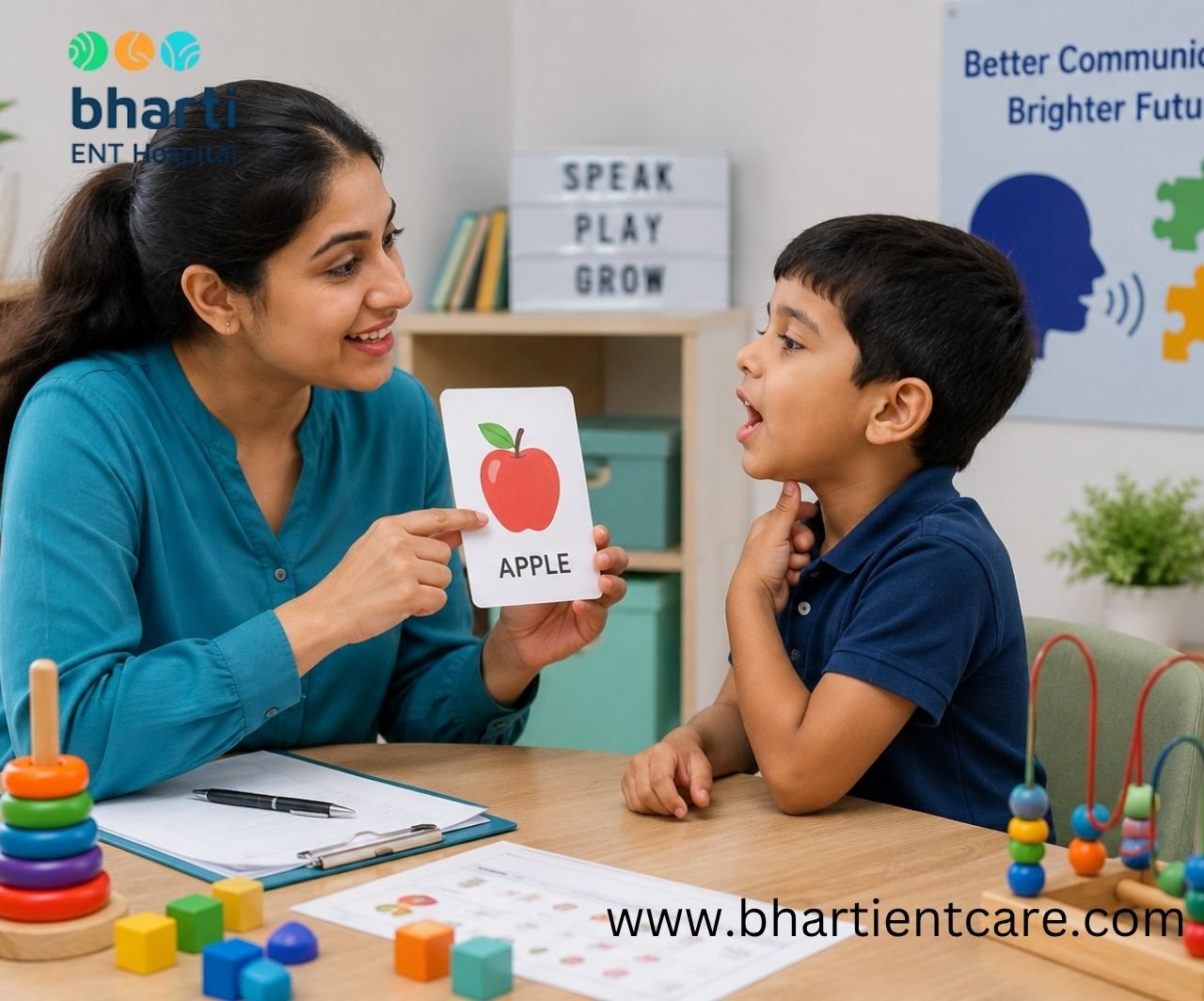
All children progress at their own rate however if there is a consistent communication problem, this may indicate a concern. A failure to recognize the early warning signs can have an impact on learning, social interactions, and self-confidence in the developing child.
Early identification of speech delay symptoms gives parents the opportunity to receive support and intervention early. At Bharti ENT Hospital, children are provided with a thorough evaluation and customized treatment plans that focus on overcoming communication difficulties and promoting positive development.
Understanding Normal Speech Development
Communication skills appear well before children are able to speak their first word. They learn from listening, watching, imitating sounds and communicating with caregivers.
Typical milestones include:
- Babbling by 6 months
- Responding to their name by 9 months
- Using simple words at around 12 months
- Combining two words by 24 months
- Speaking simple sentences by age 3
Remember, each child’s speech development may be slightly different. Persistent speech delay symptoms, however, should not be overlooked.
The mom I worked with at first thought her 3-year-old son was a “late talker.” Once evaluated, we found speech delays that responded well to early intervention and were able to see substantial improvement in communication within months.
Common Signs Your Child May Need Speech Therapy
Knowing the early signs a child needs speech therapy can encourage parents to contact professionals before the child’s academic and social functioning is impacted.
Limited Vocabulary for Age
If your child is using fewer words for their age, again and again, it could be early speech delay symptoms.
Examples include:
- Few spoken words after age 2
- Difficulty naming common objects
- Limited words to express needs verbally
Difficulty Pronouncing Words
There are some pronunciation errors that are normal in early childhood.
But children who are consistently difficult to understand beyond expected developmental stages should be evaluated.
Trouble Following Simple Instructions
Language development involves both understanding and speaking.
A child who is having difficulty with simple instructions like:
- “Bring your shoes.”
- “Come here.”
- “Give me the toy.”
may benefit from further assessment.
Limited Social Communication
Communication is not limited to speech alone. Children may exhibit concern when they:
- Avoid interactions
- Rarely initiate conversations
- Have difficulty taking turns while speaking
These can be important signs a child needs speech therapy that deserve attention.
Speech Delay vs Language Delay: Understanding the Difference
Many parents use these interchangeably, but they refer to different challenges.
Speech Delay
Speech delay is the inability to produce words and sounds. Children might be able to express their thoughts and ideas but can’t get the words correct.
Common speech delay signs and symptoms include:
- Unclear speech
- Sound substitutions
- Trouble forming some sounds
Language Delay
A language delay impacts the ability to comprehend and use words correctly.
Children may have difficulty:
- Understanding instructions
- Learning new words
- Forming sentences
- Expressing ideas
Knowing the difference will direct the proper treatment plan. As a clinician, I have seen parents be surprised when their child shows good understanding skills and yet needs therapy because of speech production issues.
When Speech Therapy Becomes Important
Many parents will ask themselves if waiting will allow their child to catch up. Children who continue to have speech delay symptoms should always be assessed by a professional.
Early Intervention Matters
Early support is highly effective, as revealed by research.
The advantages of early intervention are:
- Improved communication skills
- Greater confidence
- Better school readiness
- Enhanced social interactions
For Toddlers
It’s common for many families to delay seeking speech therapy for toddlers, thinking they may catch up later. Early intervention, however, will assist in addressing concerns before they become bigger issues.
Speech therapy for toddlers typically leads to improved communication skills during the most important years of childhood development.
For Stuttering
Not all speech concerns involve delayed language development. Fluency problems occur in some kids, such as repetitions, prolongations, or interruptions of speech.
Early speech therapy for stuttering can be used to help children learn more fluent and confident communication skills.
What Happens During a Speech Therapy Evaluation?
A professional assessment helps determine what communication difficulties are impacting a child.
A speech therapist assesses:
- Speech clarity
- Vocabulary development
- Language understanding
- Communication skills
- Social interaction abilities
Speech and language services can cover a variety of concerns at specialized centers such as delayed speech, speech articulation difficulties, language disorders, fluency difficulties and communication problems associated with developmental conditions.
The assessment process is used to develop an individual treatment plan.
Addressing Common Speech Therapy Myths
There are some misconceptions that stop parents from getting help in time. Common speech therapy myths are:
- “Boys talk later, it’s normal.”
- “My child will outgrow it.”
- “Speech therapy is only for severe issues.”
- “Therapy is unnecessary before school age.”
Assumptions can cause delays in essential interventions as each child develops individually.
One family that I worked with postponed evaluation because family members continue to let them know that the child will “start talking” someday. Following the therapy, the child’s communication increased dramatically, pointing to the necessity of proper evaluation.
Benefits of Speech Therapy for Children
The benefits of speech therapy go far beyond speech production. Children may see improvements in:
Communication Confidence
Children feel more at ease communicating needs, thoughts and feelings.
Academic Readiness
Good communication skills aid in:
- Reading development
- Classroom participation
- Learning comprehension
Social Relationships
Good communication allows children to:
- Build friendships
- Engage in group activities
- Develop stronger social connections
Family Interaction
Parents often say that after therapy, their frustration levels have decreased and having more meaningful interactions with their children.
Speech therapy for toddlers can be a helpful resource for many families that can contribute to ongoing success.
Supporting Your Child at Home
While professional therapy is essential, parents can also be a crucial component of communication development. Practical strategies include:
- Reading together daily
- Encouraging conversation
- Restricting passive screen time
- Naming objects during daily activities
- Responding positively to communication attempts
Be vigilant for any persistent speech delay symptoms and consult qualified professionals about concerns rather than waiting indefinitely.
Persistent communication problems, repeated indicators that a child requires speech therapy, or ongoing language development problems are often indicators for early evaluation.
Recognizing Early Signs of Speech Delay
The speech therapy and language therapy provided at Bharti ENT Hospital focus on individual assessment and evidence-based treatment to enhance children’s communication abilities. Providing timely professional intervention when speech delay symptoms are identified can significantly impact a child’s confidence, learning and quality of life.
Frequently Asked Questions (FAQs)
What are the common signs that a child may need speech therapy?
Common symptoms include delayed speech, unclear speech, trouble following directions, a limited vocabulary and problems with communication.
At what age should a child start talking?
Around 12 months, most children are saying their first words and by approximately 24 months, they are starting to string words together.
How do I know if my child’s speech development is delayed?
If a child has ongoing speech problems, a small vocabulary, and has communication skills that are well below those of children their age, it can be a sign of delay.
What is the difference between a speech delay and a language delay?
Speech delays are those that impact the production of sound, and language delays are those that impact understanding and using language effectively.
Can a child outgrow speech problems without therapy?
While some minor delays resolve on their own, continued concerns will need to be assessed by a professional to prevent missed opportunities for intervention.
When to see a speech therapist?
Parents should seek an evaluation if speech, language, or communication development is significantly delayed or if they have concerns.